
Ohm's Law & Resistance
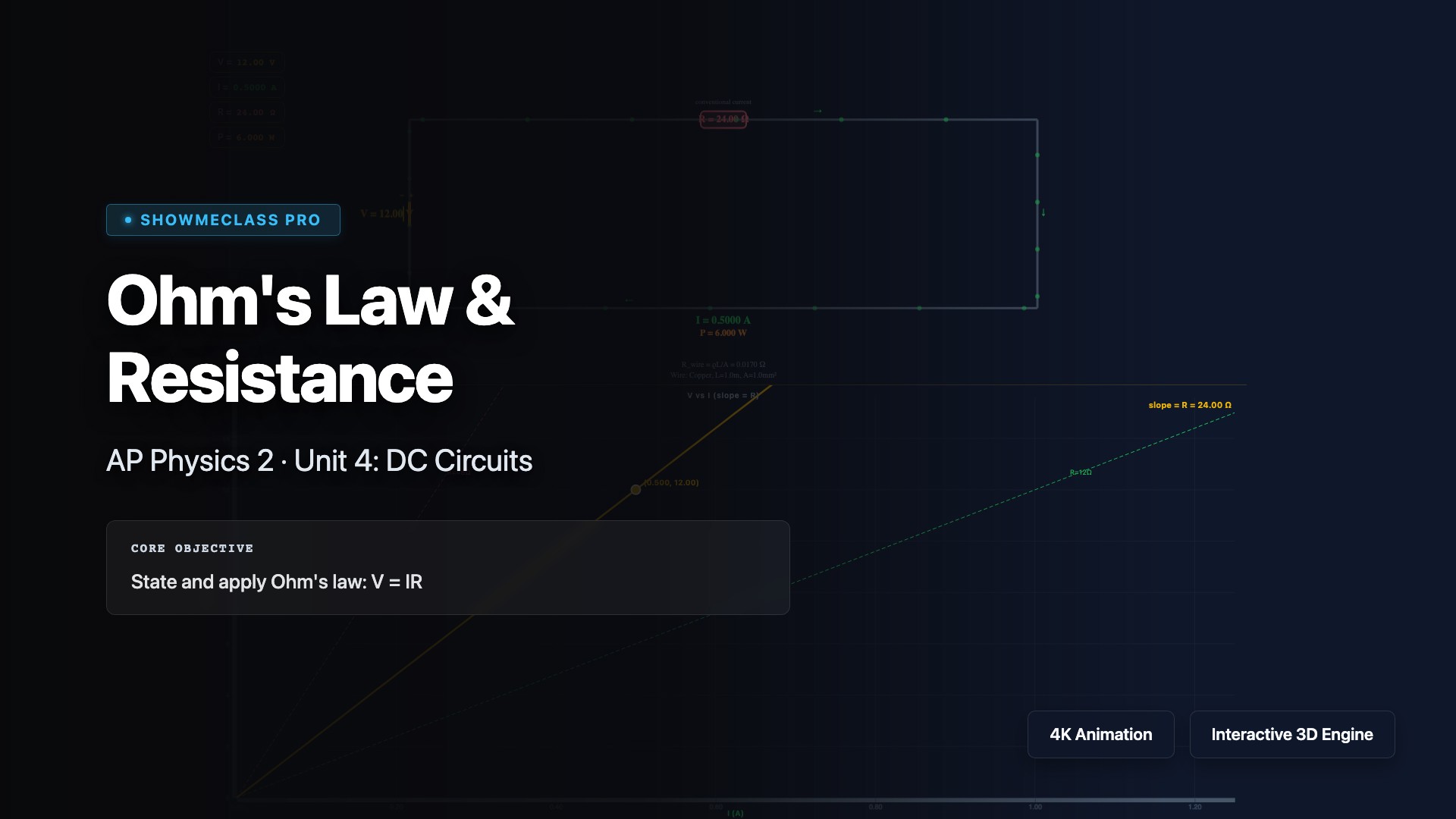
Explore Ohm's Law stating that voltage across a conductor is proportional to current: V = IR, where R is resistance measured in ohms. Understand how resistance depends on material properties (resistivity ρ), length, and cross-sectional area: R = ρL/A. Calculate power dissipation using P = IV = I²R = V²/R. Analyze how temperature affects resistance, and apply Ohm's Law to solve circuit problems involving series and parallel resistor combinations.
Series & Parallel Circuits
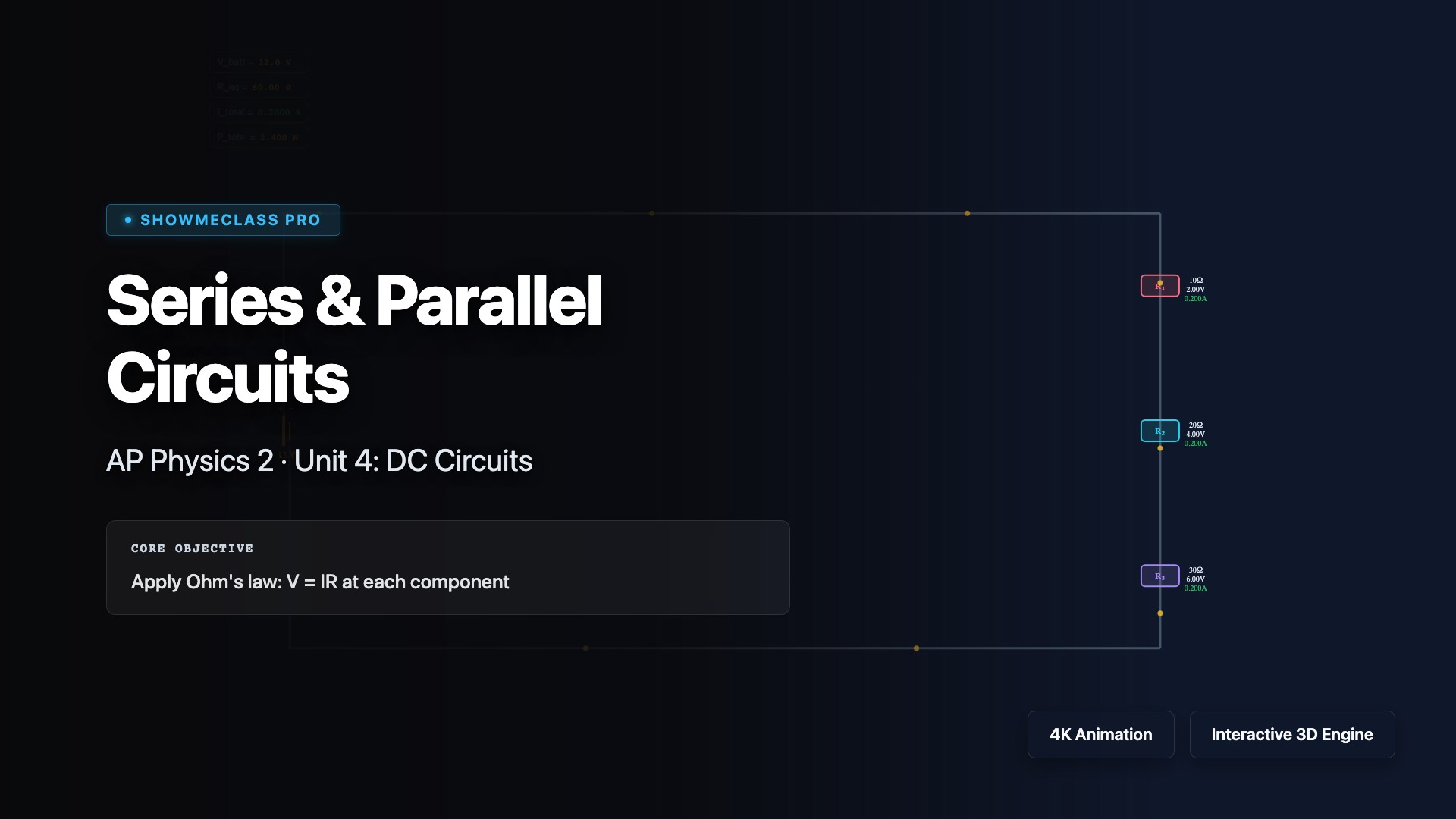
Compare series circuits (single current path, voltage divides, Req = R₁ + R₂ + ...) with parallel circuits (multiple current paths, voltage same across branches, 1/Req = 1/R₁ + 1/R₂ + ...). Apply Kirchhoff's voltage law (sum of voltage drops equals EMF) and current law (current in equals current out at junctions). Analyze complex circuits with mixed series-parallel combinations, calculate equivalent resistance, and determine current and voltage across each component.

RC Circuit Charging & Discharging
Analyze RC circuits where capacitors charge and discharge through resistors with exponential time dependence. Understand the time constant τ = RC that characterizes how quickly the capacitor charges to 63% of maximum voltage or discharges to 37% of initial voltage. Visualize voltage and current curves using Q(t) = Q₀(1 - e^(-t/τ)) for charging and Q(t) = Q₀e^(-t/τ) for discharging. Apply RC circuits to timing applications, filters, and camera flashes.