
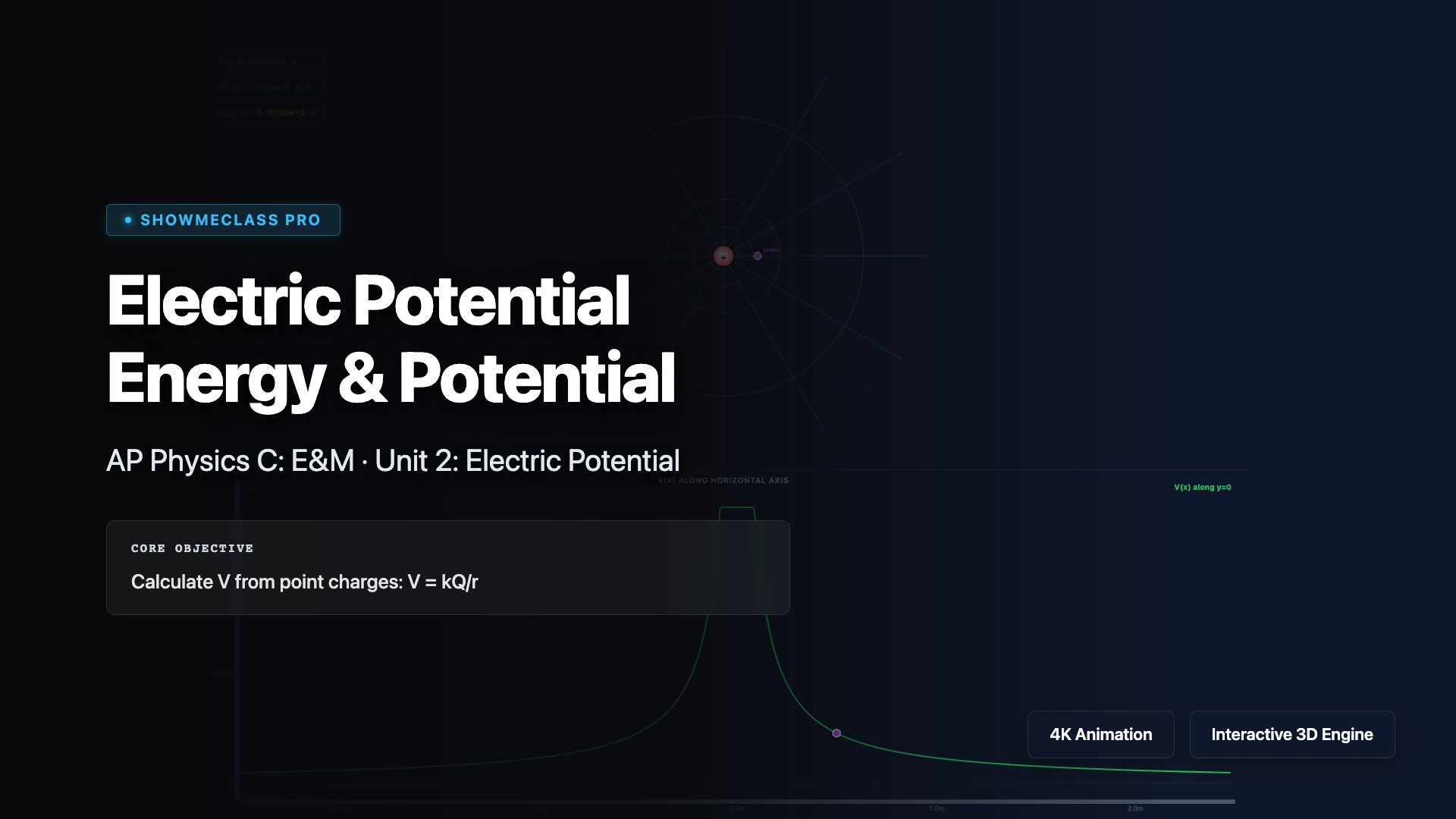
Electric Potential Energy & Potential
Calculate electric potential $V = \frac{kQ}{r}$ and potential energy $U = qV$ for point charges and charge distributions. Visualize equipotential surfaces, explore the relationship $\vec{E} = -\nabla V$, and analyze how charges move from high to low potential.

Maxwell's Equations Overview
Explore the four Maxwell's equations that unify electricity and magnetism: Gauss's law, Gauss's law for magnetism, Faraday's law, and Ampère-Maxwell law. Visualize how these equations predict electromagnetic wave propagation and the interconnection between electric and magnetic fields.
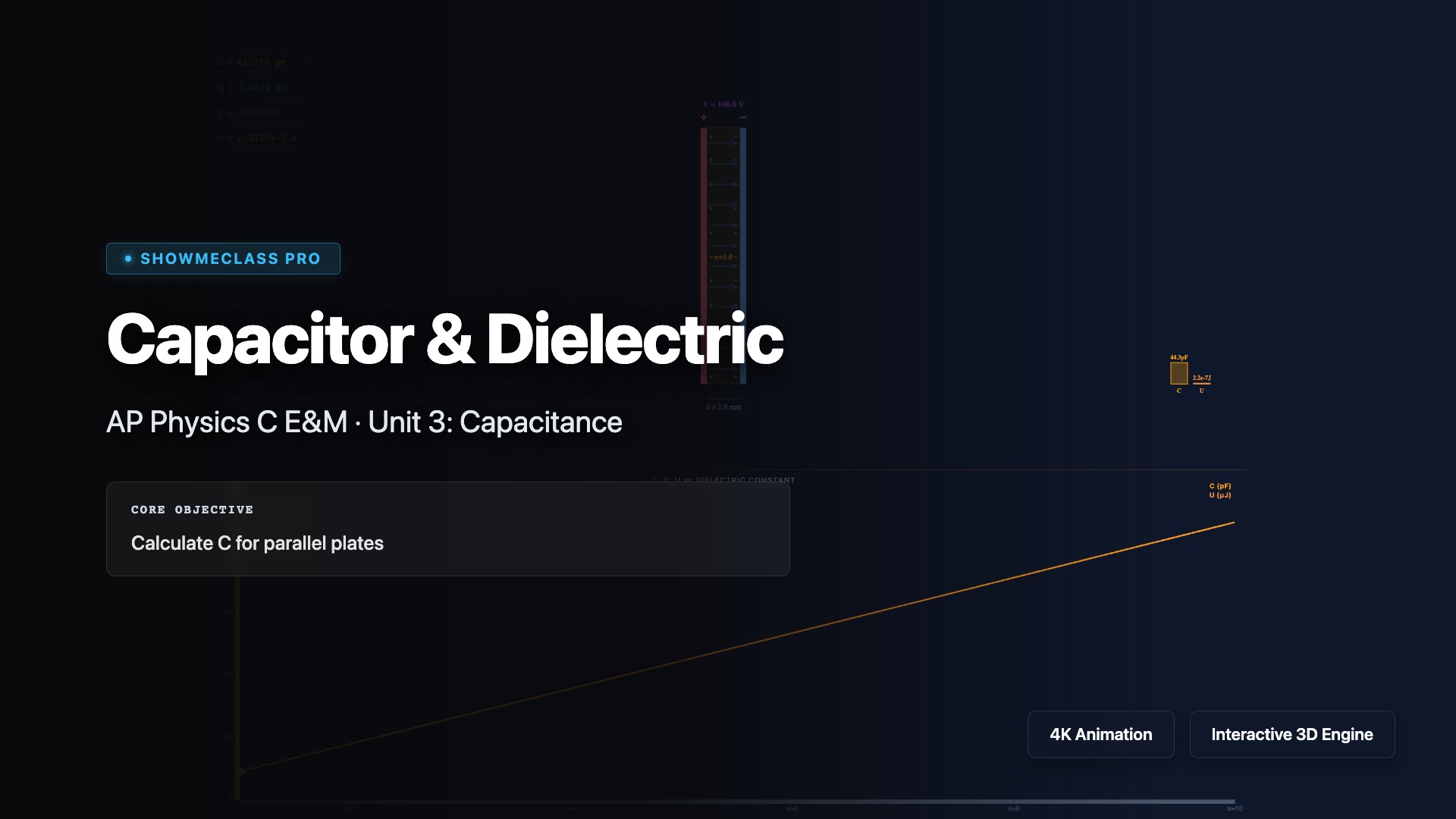
Capacitor & Dielectric
Explore capacitance $C = \frac{Q}{V}$ and how dielectric materials increase capacitance by reducing the electric field. Visualize energy storage $U = \frac{1}{2}CV^2$ in parallel-plate capacitors and analyze the effects of dielectric constant on charge distribution.
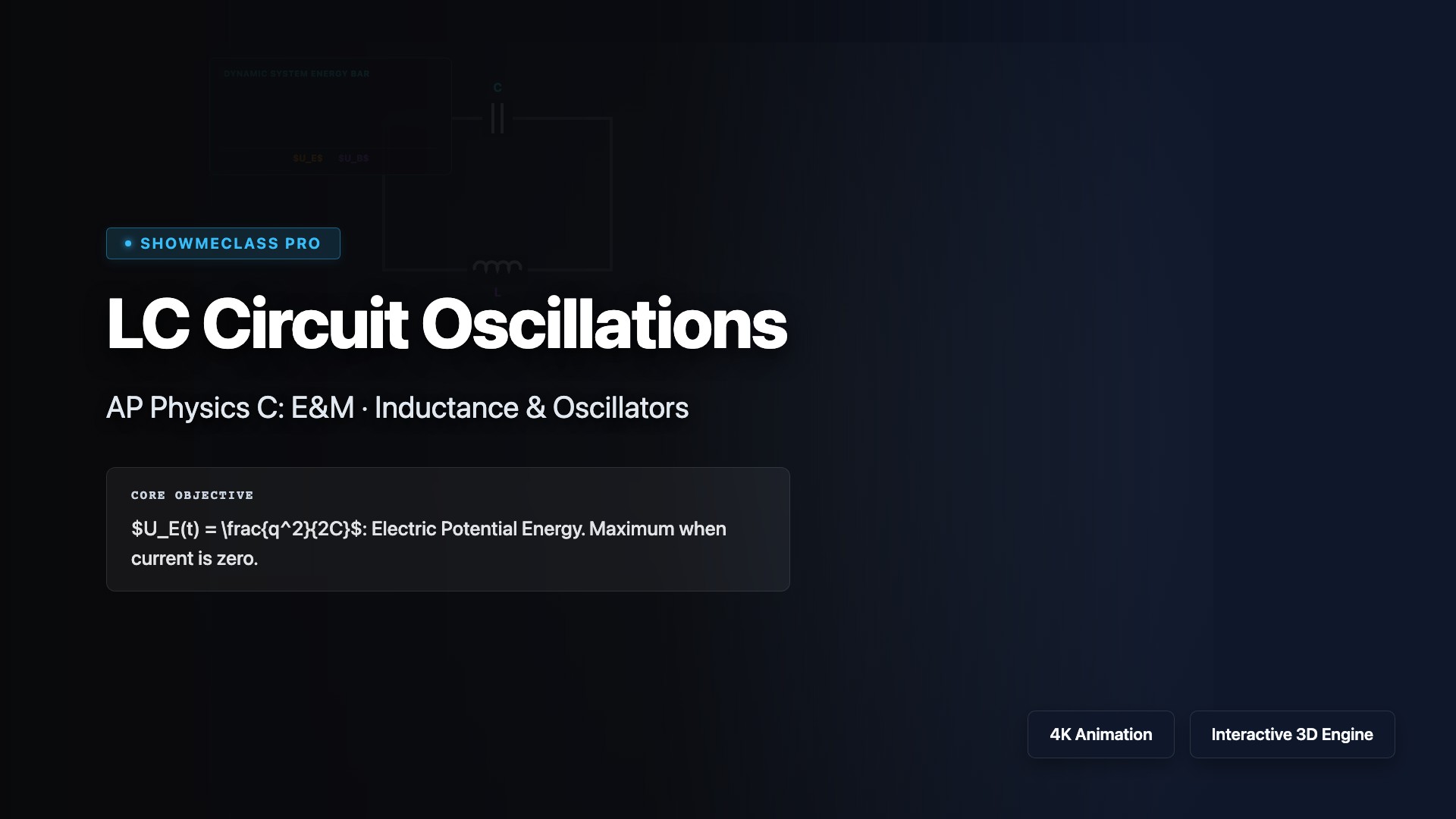
LC Circuit Oscillations
Visualize the differential oscillation of energy between an inductor's magnetic field and a capacitor's electric field. Live graphs of charge and current.
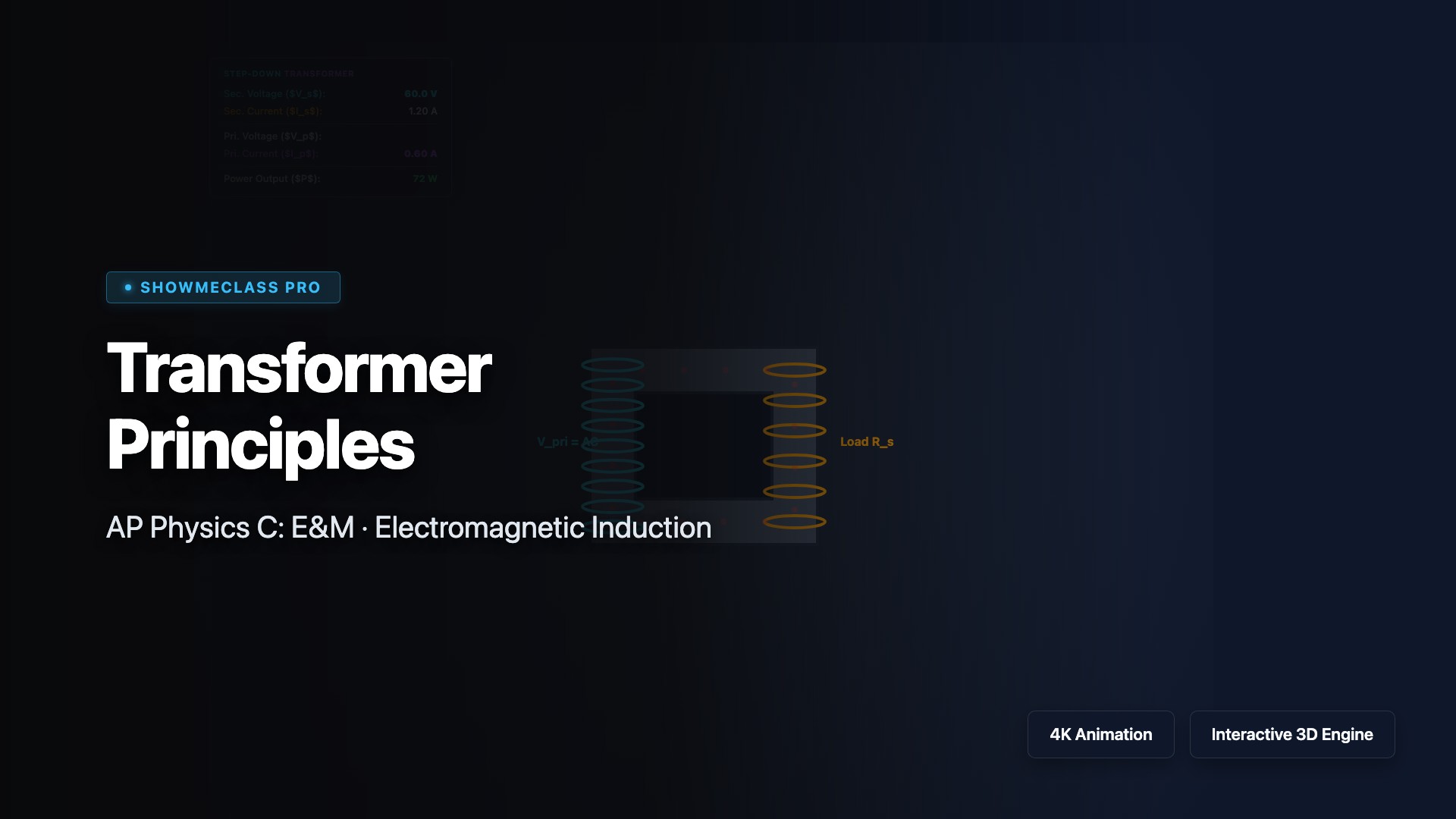
Transformer Principles
Simulate an ideal transformer using Faraday's Law. Adjust primary/secondary turns and voltages to see magnetic flux transfer and conserve power.

Biot-Savart Law & Magnetic Field
Calculate magnetic fields using the Biot-Savart law $d\vec{B} = \frac{\mu_0}{4\pi}\frac{Id\vec{l} \times \hat{r}}{r^2}$ for current-carrying wires. Visualize how current elements contribute to the total magnetic field and explore field patterns around straight wires, loops, and complex geometries.

Electric Field & Gauss's Law
Apply Gauss's law $\oint \vec{E} \cdot d\vec{A} = \frac{Q_{enc}}{\epsilon_0}$ to calculate electric fields for symmetric charge distributions. Visualize electric flux through Gaussian surfaces and solve for fields around spheres, cylinders, and infinite planes using symmetry arguments.
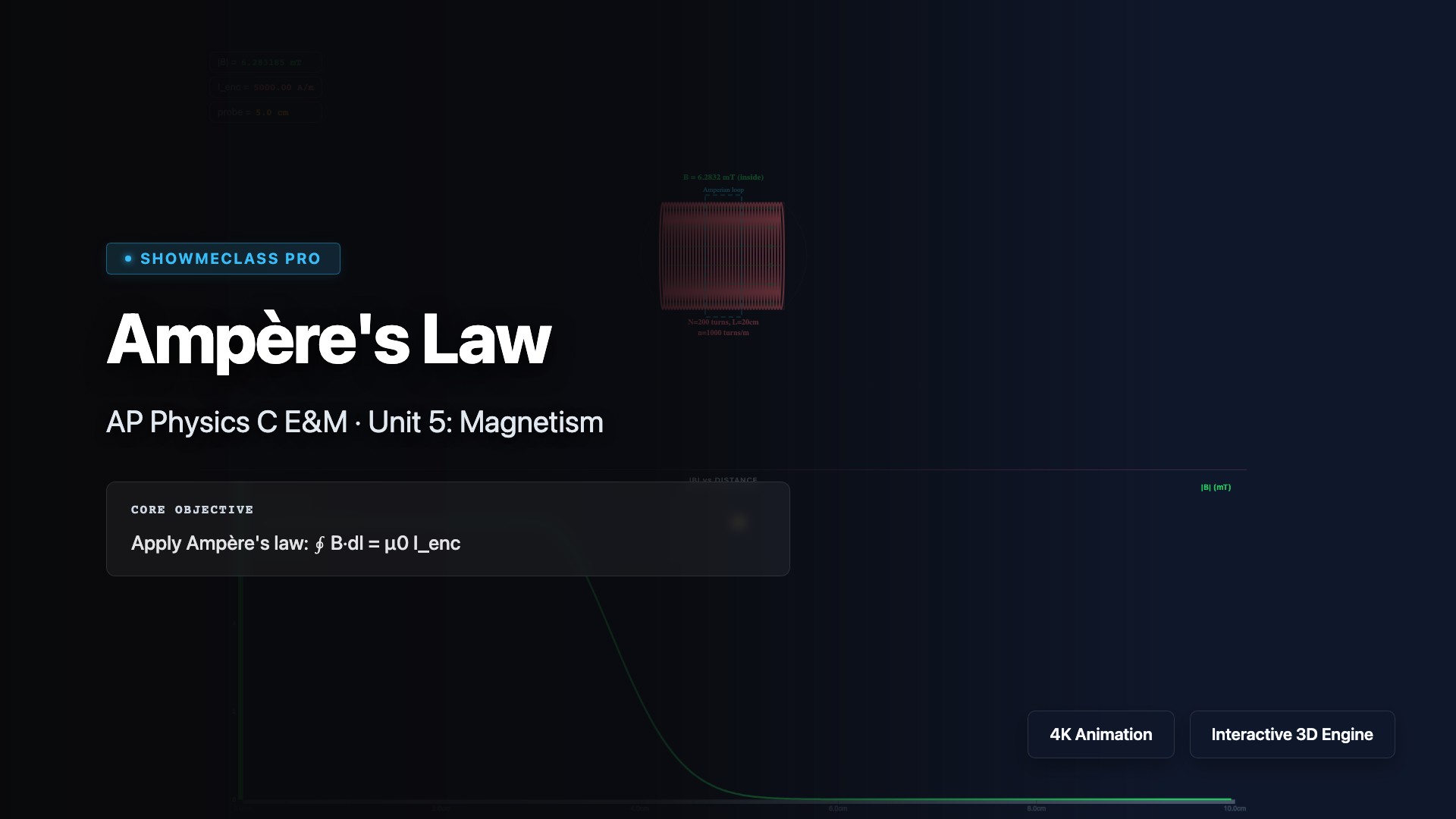
Ampère's Law
Apply Ampère's law $\oint \vec{B} \cdot d\vec{l} = \mu_0 I_{enc}$ to calculate magnetic fields in symmetric configurations. Visualize magnetic field patterns inside solenoids, toroids, and around current-carrying wires using closed loop integration.
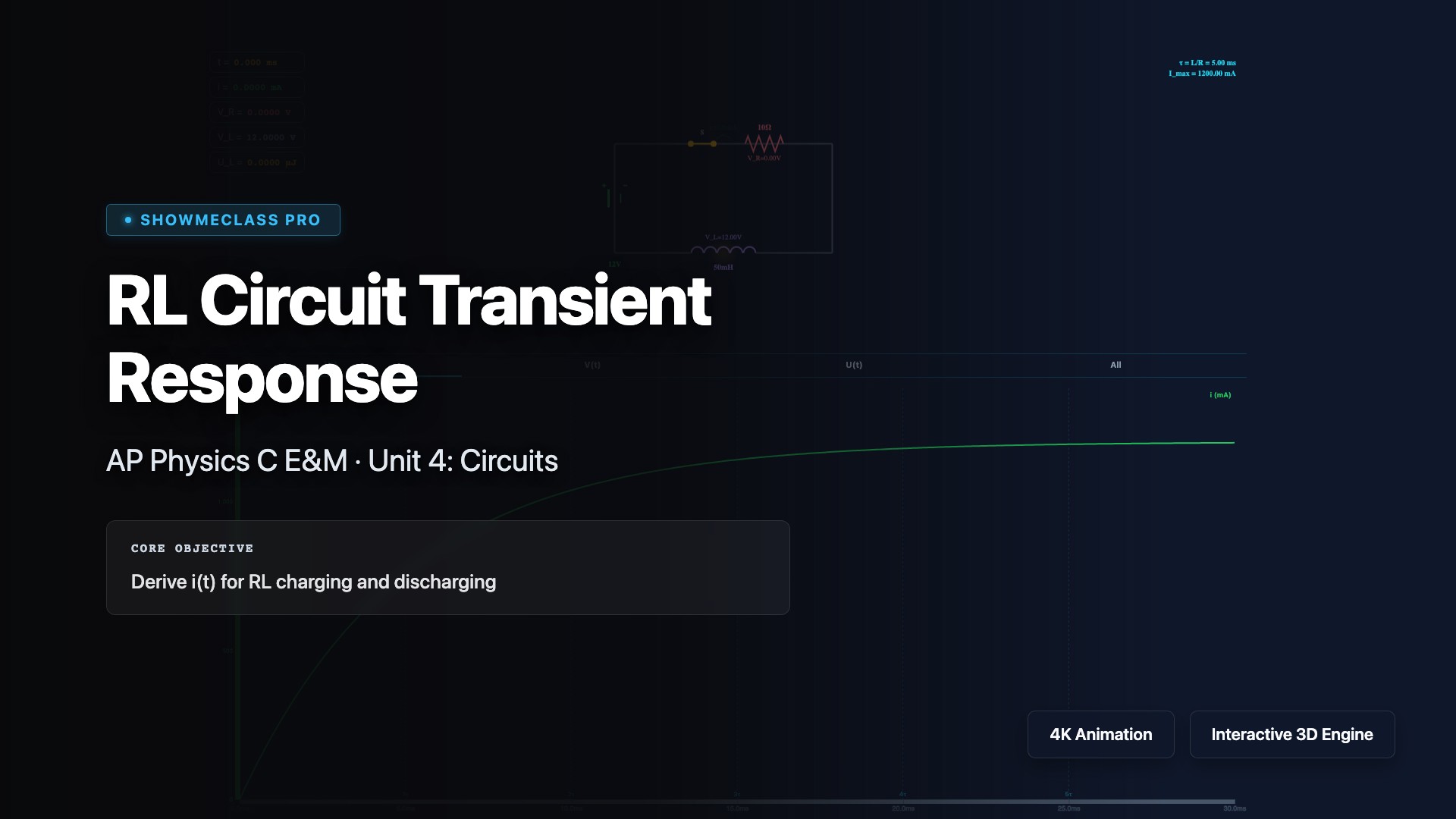
RL Circuit Transient Response
Analyze RL circuit behavior with exponential current growth $I(t) = I_0(1 - e^{-t/\tau})$ where $\tau = L/R$ is the time constant. Visualize how inductors resist current changes, store magnetic energy, and create transient responses when switches open or close.

Faraday's Law & Lenz's Law
Apply Faraday's law $\mathcal{E} = -\frac{d\Phi_B}{dt}$ to calculate induced EMF from changing magnetic flux. Visualize how Lenz's law determines the direction of induced current to oppose flux changes, and explore applications in generators and transformers.
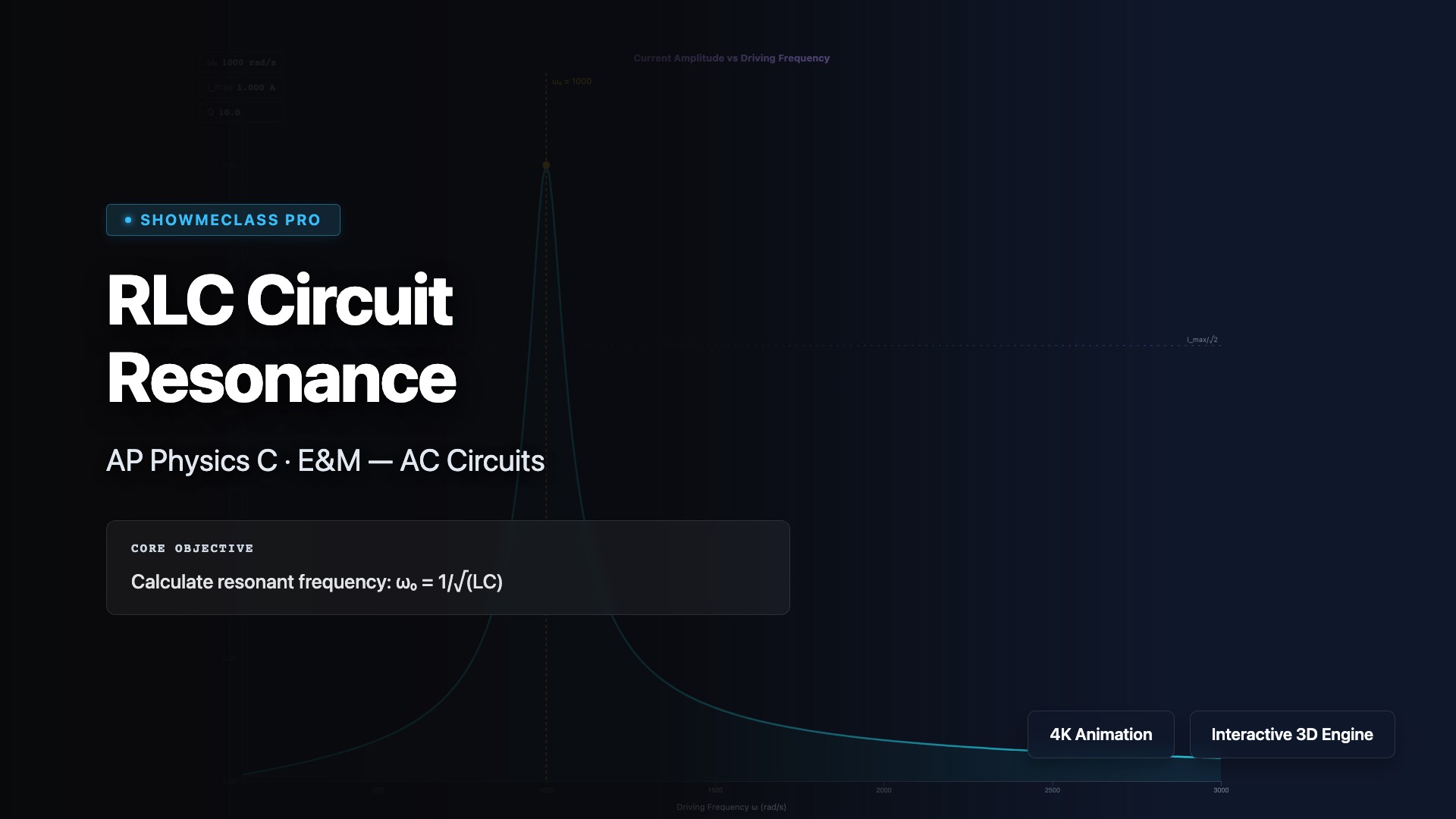
RLC Circuit Resonance
Explore series RLC resonance by sweeping driving frequency. See current amplitude peak at ω₀ = 1/√(LC), impedance minimum at Z = R, and quality factor determining bandwidth.

AC Circuit Phasor Diagrams
Animated phasor diagram showing V_R, V_L, V_C rotating vectors with real-time waveforms. Adjust ω, R, L, C to see phase angle φ and power factor change dynamically.
Magnetic Flux & Faraday/Lenz's Law
Visualize Maxwell's equations in action. Drag a permanent magnet through an Amperian coil and observe how dΦ/dt directly induces an opposing EMF spike dictated by Lenz's Law.
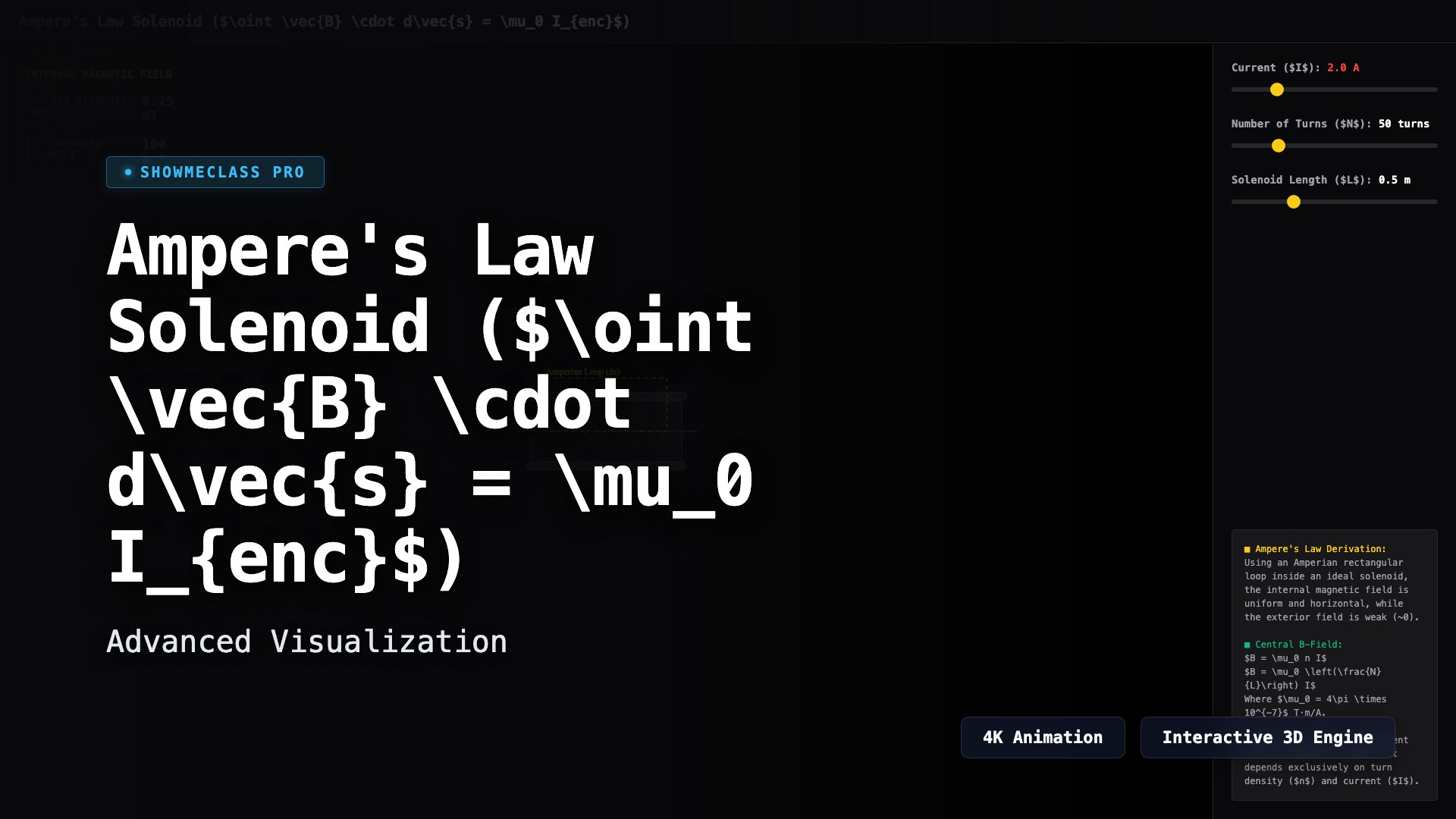
Ampere's Law Solenoid Constructor
Construct an ideal solenoid and visualize the uniform internal magnetic field utilizing Ampere's Law. Adjust current I, solenoid length L, and turn count N to map B-field intensity.

Hall Effect Sensor Lab
Inject current through a conducting slab placed in a transverse magnetic field to visualize the buildup of charge on the edges, generating the measuarble, transverse Hall Voltage.
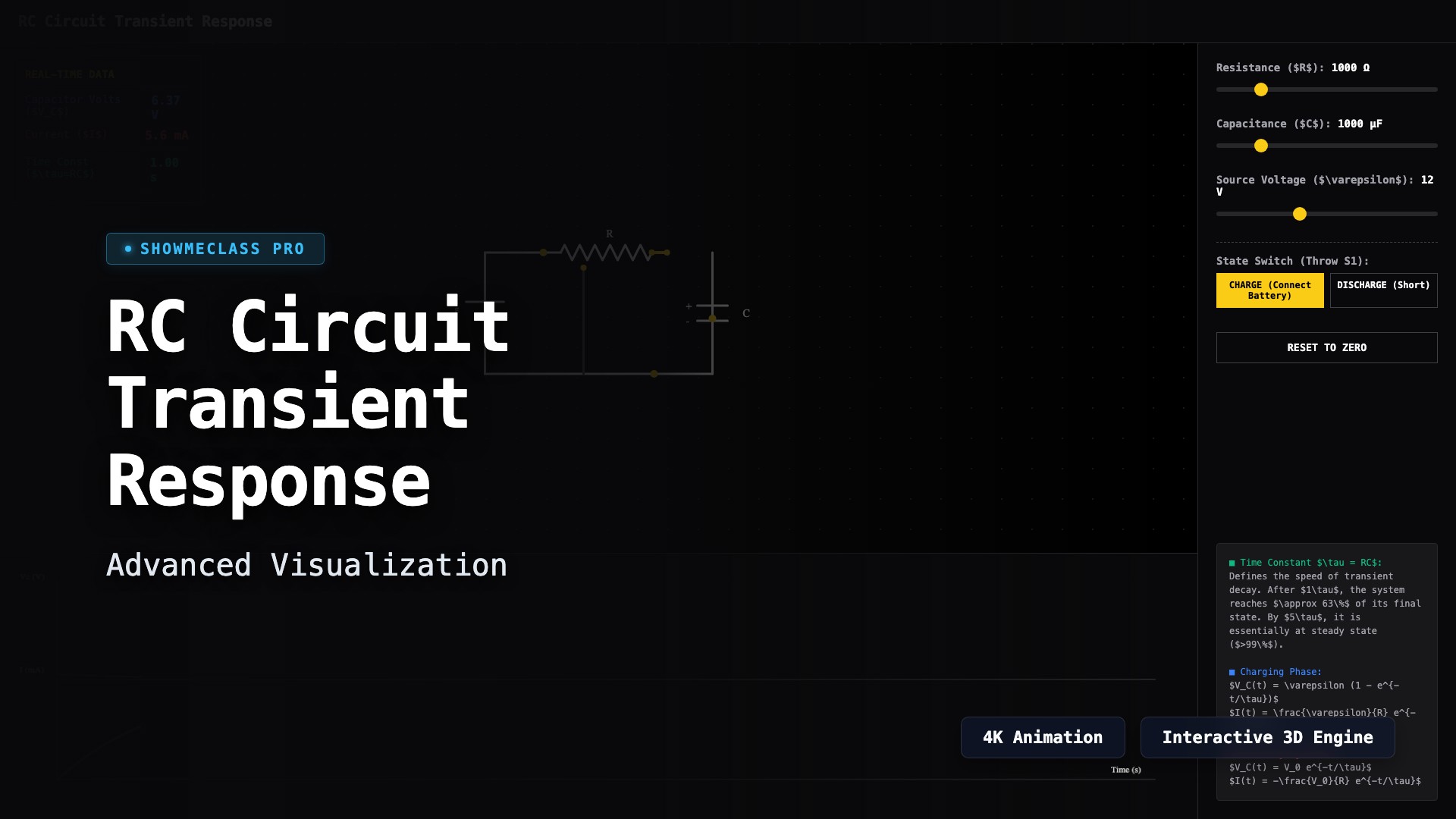
RC Circuit Transient Response
Analyze the asymptotic decay curves of isolated RC Circuits. Switch between charging and discharging phases to plot Voltage and Current dynamically against the Time Constant (τ = RC).
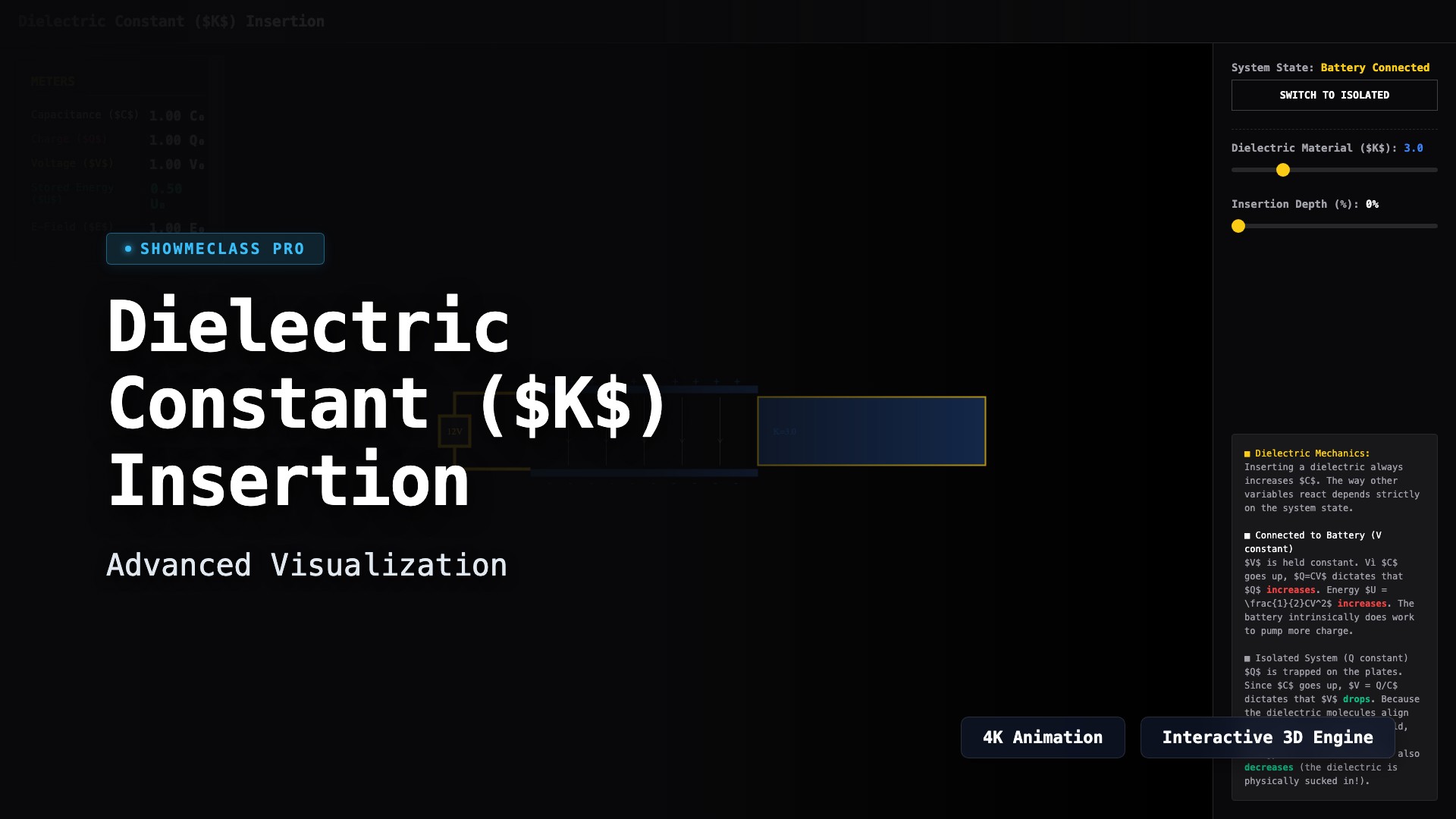
Capacitors with Dielectric Insertion
Visualize how pushing a dielectric constant (K) between parallel plates dynamically shifts Capacitance, Charge, Voltage, stored Energy (U), and E-Field intensity. Compare connected vs isolated scenarios.

Lorentz Force 3D Particle Accelerator
Fire charged particles into a uniform magnetic field. Visualize cyclotronic motion derived from the cross product F = q(v × B) and measure the resulting orbital radius based on mass, velocity, and charge.
Biot-Savart Law 3D Visualizer
Visualize the 3D magnetic field vectors B generated by steady currents. Switch between straight conductive wires, circular loops, and solenoids to understand the Right Hand Rule and spatial 1/r² decay.

Electric Field & Equipotential Mapper
Interactive Gaussian graph paper. Map directional vectors of Electric Fields and prove they are perpendicular to drawn Equipotential surfaces.