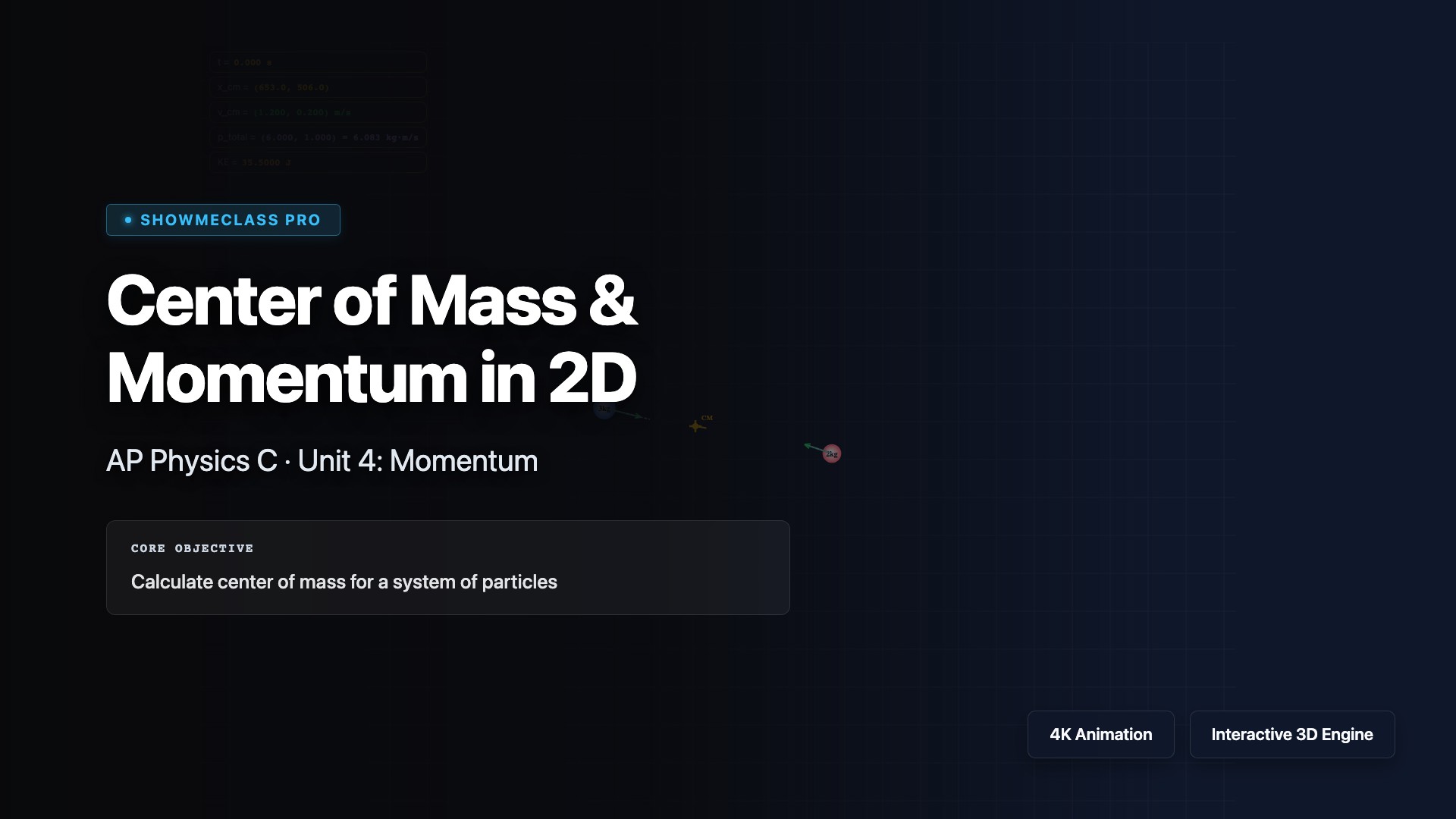
2D Center of Mass Collision Simulator
Simulate 2D elastic collisions from both the Laboratory and Center of Mass reference frames. Visualize how the total momentum in the COM frame always remains exactly zero, creating perfectly symmetric scattering trajectories.
THE CENTER OF MASS SYSTEM
The motion of a system of particles can be simplified by focusing on its **Center of Mass (CM)**. In the absence of external forces, the CM moves with a constant velocity (). This principle is vital in Unit 4 (Systems of Particles). When two objects collide, their internal forces change their individual velocities, but the CM trajectory remains an unchanging straight line (or stationary if ).
CONSERVATION OF MOMENTUM IN 2D
Linear momentum is a vector quantity (). In a 2D collision, momentum is conserved independently in the and directions: and . By analyzing a collision from the CM frame, the total momentum is always zero (), which often simplifies complex glancing collisions into symmetrical scattering events.
HOW TO USE THIS VISUALIZATION
1. **Launch Collisions**: Set the initial mass and velocity for two disks and watch them collide on a frictionless surface. 2. **Toggle CM Trace**: Enable the "Center of Mass" overlay to see the path of the system's balance point. 3. **Switch Reference Frames**: Toggle between the Lab Frame (static background) and the CM Frame (the camera follows the CM). 4. **Elastic vs. Inelastic**: Adjust the coefficient of restitution () to see how energy is lost while momentum remains conserved.
CORE FORMULAS
AP EXAM CONNECTION
Unit: Unit 4: Systems of Particles and Linear Momentum (Topic 4.2, 4.3)
Learning Objective: CON-4.A, CON-4.B
COMMON MISCONCEPTIONS
- Thinking internal forces can change the velocity of the center of mass (only external forces can).
- Forgetting to treat momentum as a vector (you must resolve and components independently).
- Confusing conservation of momentum with conservation of kinetic energy.
KEY TAKEAWAYS
- The CM of a system follows a path determined only by external forces.
- Total linear momentum is conserved in all isolated collisions.
- Collisions are often easier to analyze in the CM reference frame.
- In 2D, you must use vector components ( and ) to solve for unknowns.
PRACTICE QUESTIONS
Q1 (CONCEPTUAL): Two objects of equal mass collide. If one was at rest and the collision is perfectly elastic and glancing, what is the angle between their final velocity vectors?
Show Answer & Explanation
Answer:
Explanation: In a 2D elastic collision between equal masses where one is initially at rest, the conservation of momentum and kinetic energy dictate that the final velocities must be perpendicular.
Q2 (QUANTITATIVE): A 2kg mass moving at 4m/s in the direction collides and sticks to a 2kg mass at rest. What is the final velocity of the center of mass?
Show Answer & Explanation
Answer: 2m/s
Explanation: m/s.