
Showing 12 results
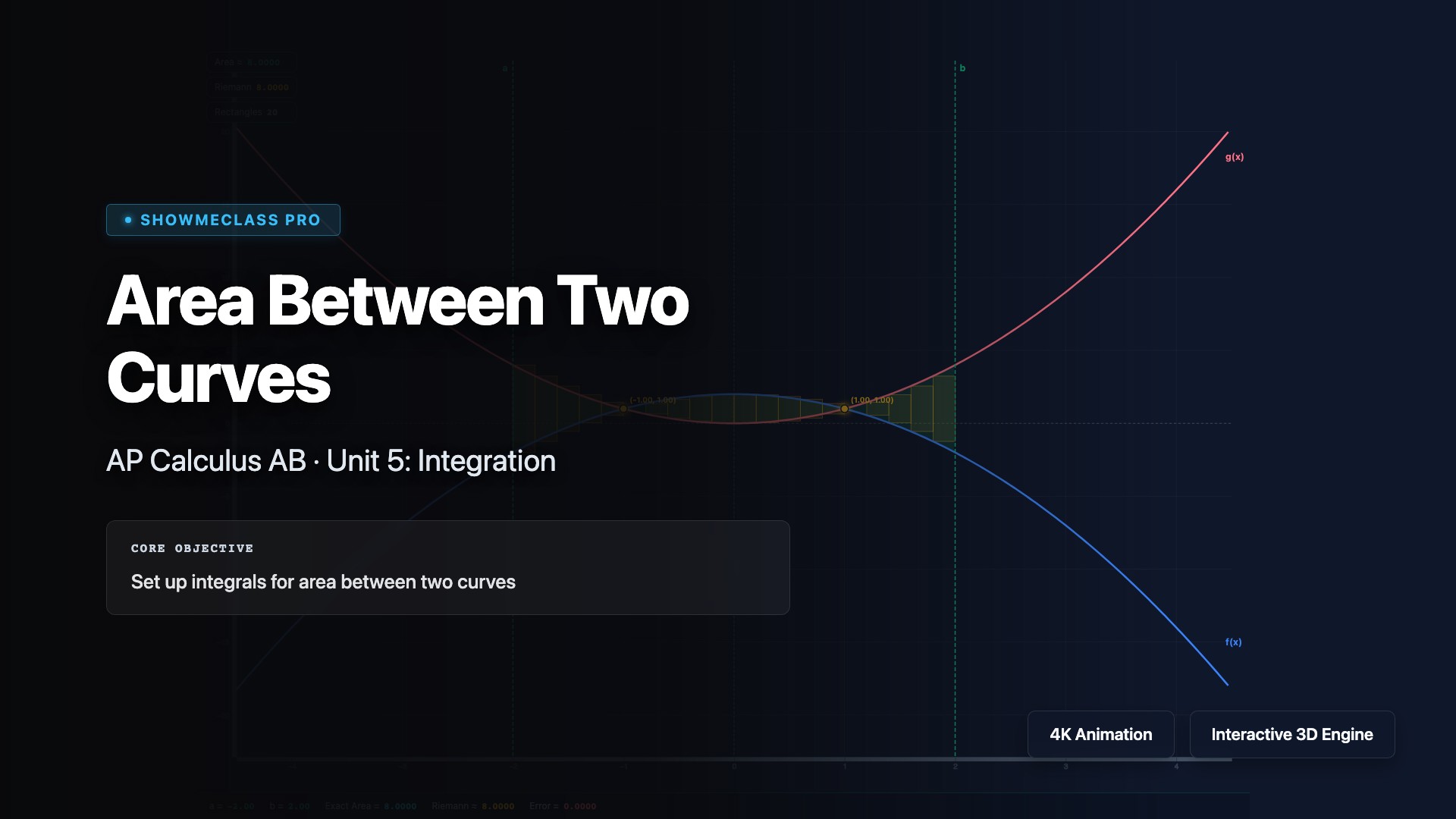
Area Between Two Curves
Visualize and calculate the area between two curves using definite integrals. Explore how to find intersection points, determine which function is on top, and set up the integral ∫[a to b] (f(x) - g(x))dx. Practice with vertical and horizontal slicing methods, and understand applications in physics, economics, and geometry where finding regions between curves is essential.
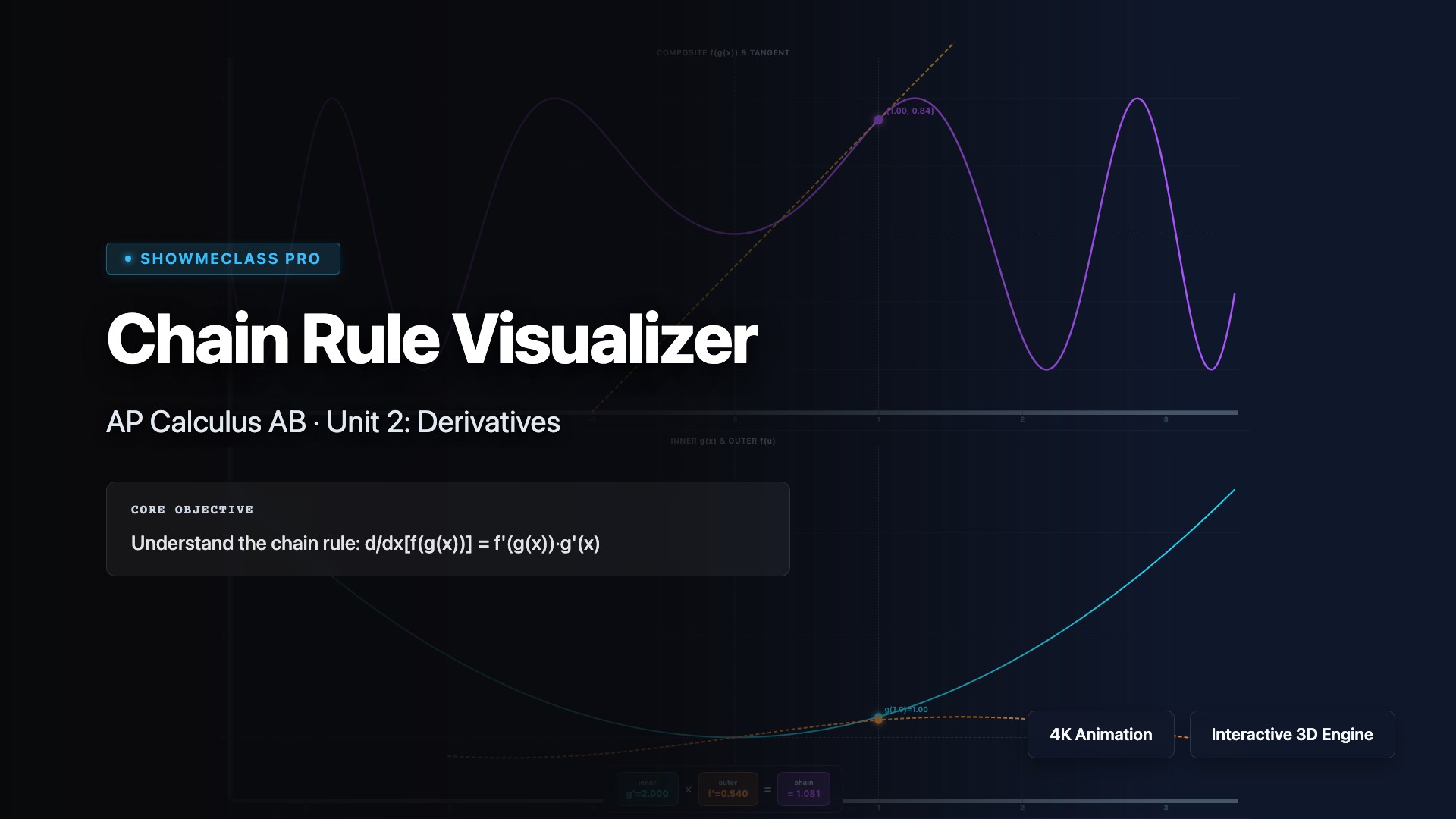
Chain Rule Visualizer
Visualize the chain rule for differentiating composite functions, one of the most powerful differentiation techniques in calculus. Explore how d/dx[f(g(x))] = f'(g(x)) · g'(x) by decomposing nested functions into outer and inner components. Practice identifying composite functions, applying the chain rule step-by-step, and understanding how rates of change multiply through function composition.
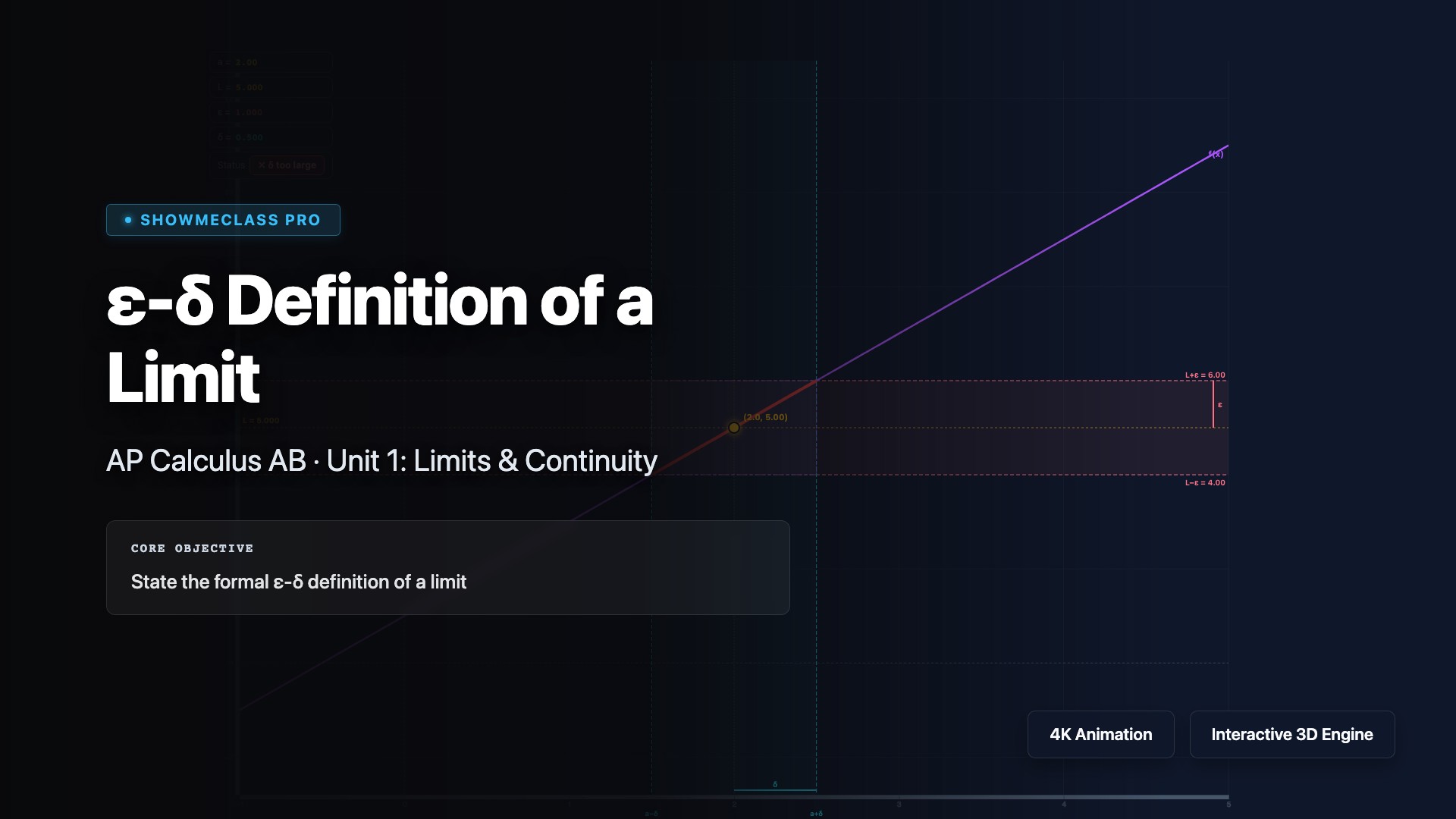
ε-δ Definition of a Limit
Explore the rigorous epsilon-delta (ε-δ) definition of a limit, the formal foundation of calculus. Visualize how for every ε > 0, there exists a δ > 0 such that if 0 < |x - c| < δ, then |f(x) - L| < ε. Understand how this definition precisely captures the intuitive notion that f(x) approaches L as x approaches c, and practice constructing epsilon-delta proofs.
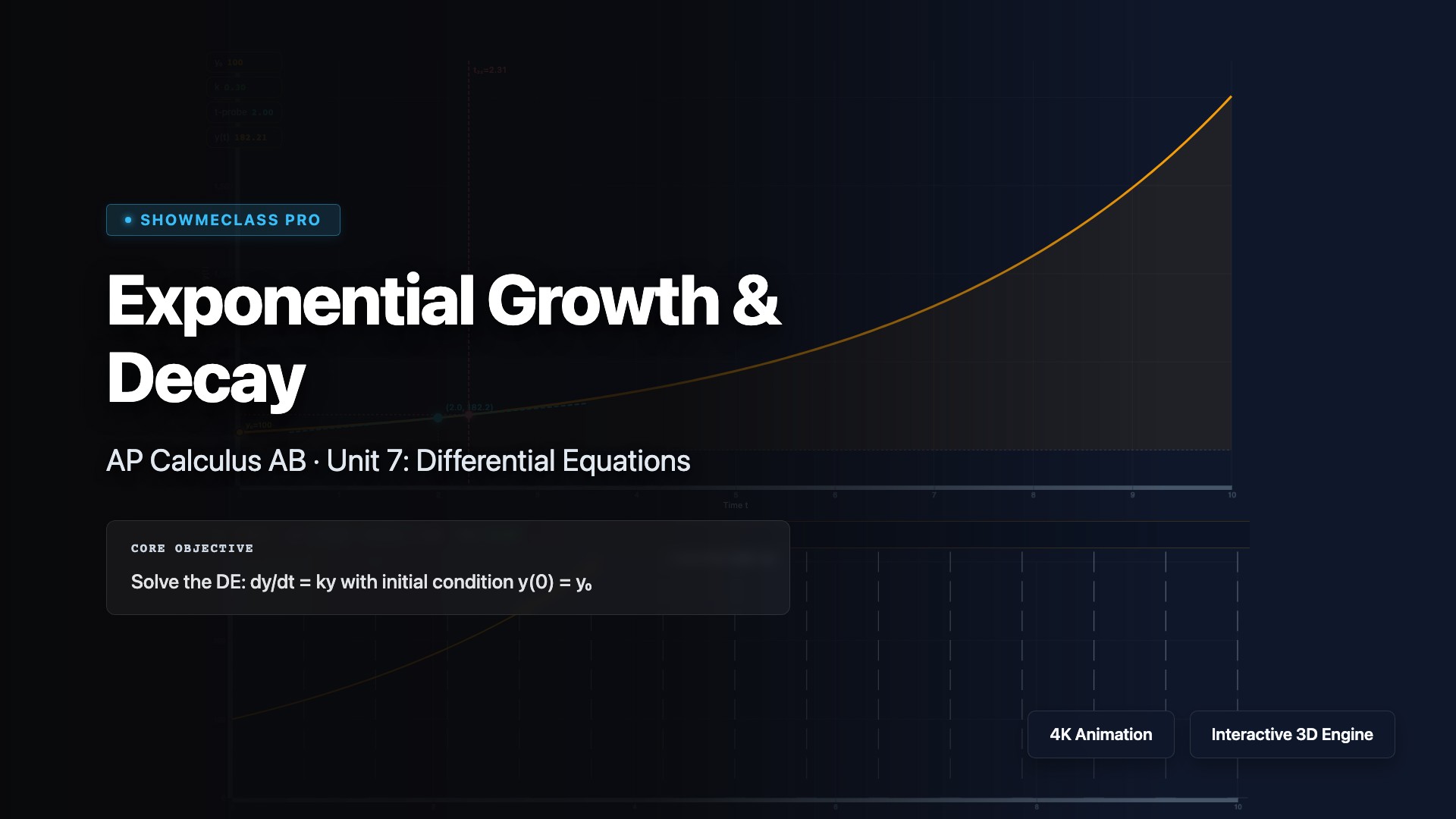
Exponential Growth & Decay
Model exponential growth and decay processes using differential equations of the form dy/dt = ky. Explore how the solution y = y₀e^(kt) describes phenomena like population growth, radioactive decay, compound interest, and Newton's law of cooling. Understand the significance of the growth constant k, half-life, and doubling time in real-world applications across biology, physics, and finance.
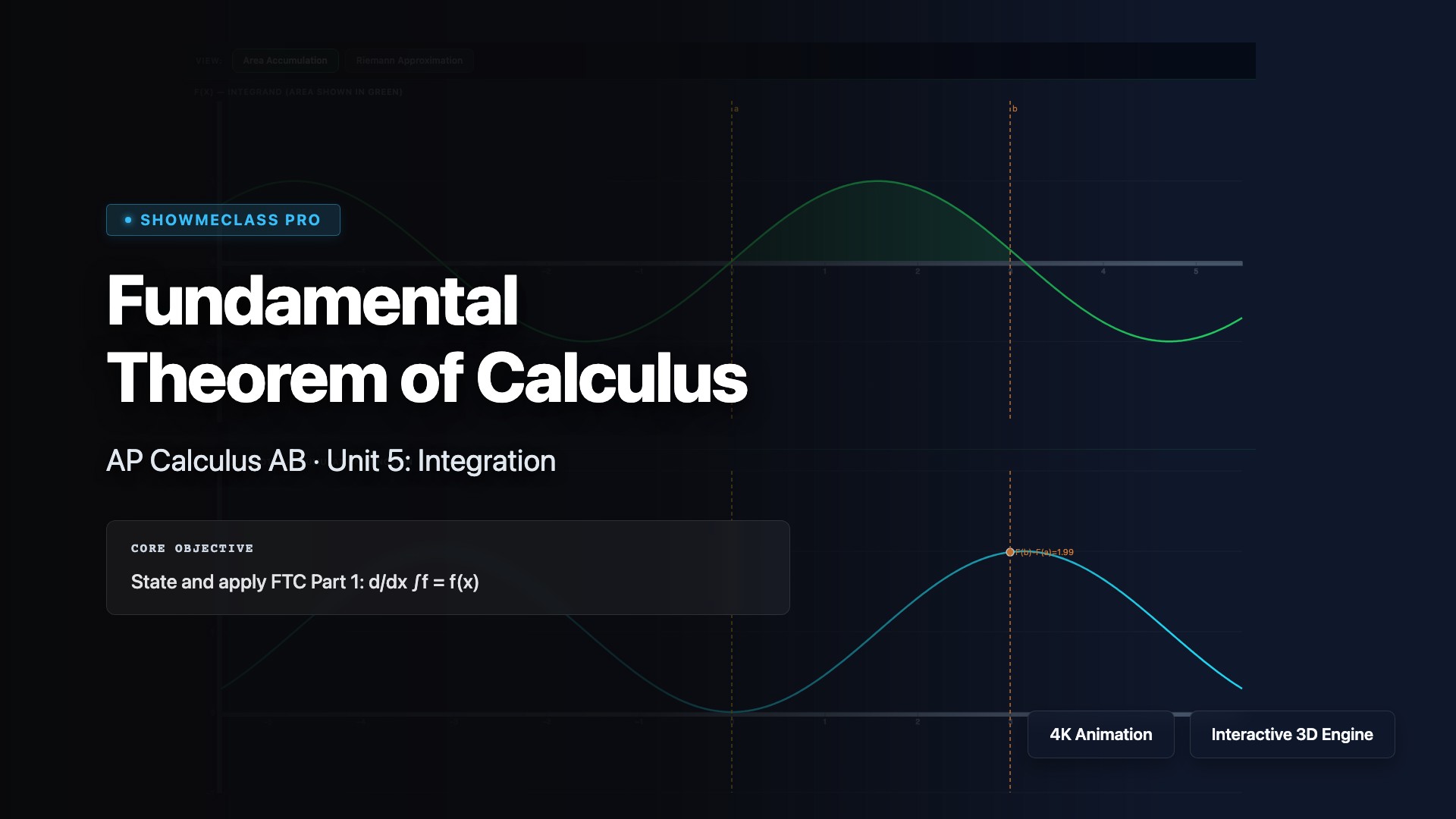
Fundamental Theorem of Calculus
Explore the Fundamental Theorem of Calculus, which connects differentiation and integration as inverse operations. Visualize Part 1: if F(x) = ∫[a to x] f(t)dt, then F'(x) = f(x), and Part 2: ∫[a to b] f(x)dx = F(b) - F(a) where F is any antiderivative of f. Understand how this theorem enables efficient calculation of definite integrals and reveals the deep relationship between rates of change and accumulation.
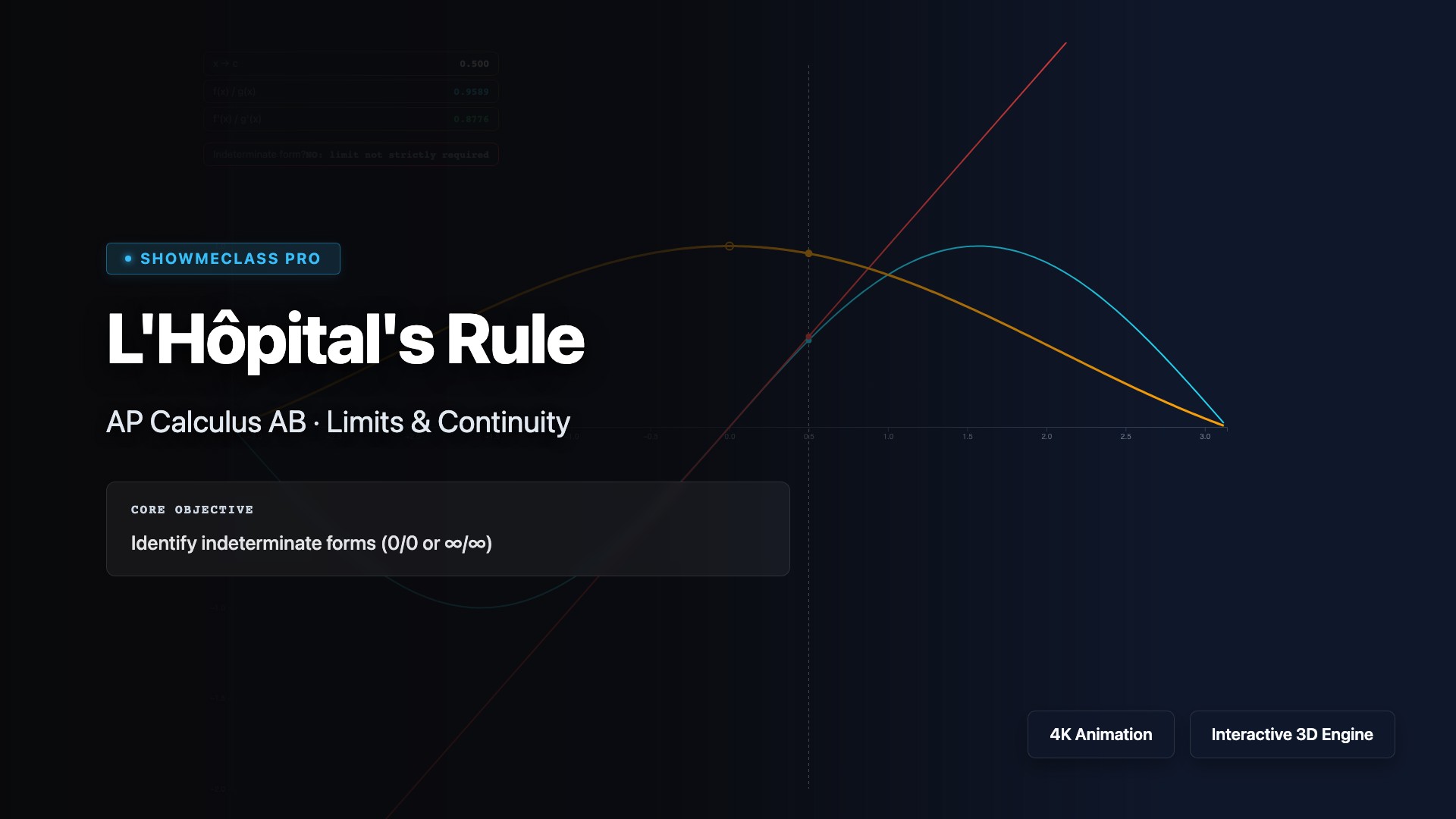
L'Hôpital's Rule
Apply L'Hôpital's Rule to evaluate indeterminate forms like 0/0 and ∞/∞ by taking derivatives of the numerator and denominator. Visualize how lim[x→c] f(x)/g(x) = lim[x→c] f'(x)/g'(x) when the original limit produces an indeterminate form. Practice identifying when to apply the rule, handling repeated applications, and recognizing other indeterminate forms like 0·∞, ∞-∞, 0⁰, 1^∞, and ∞⁰.
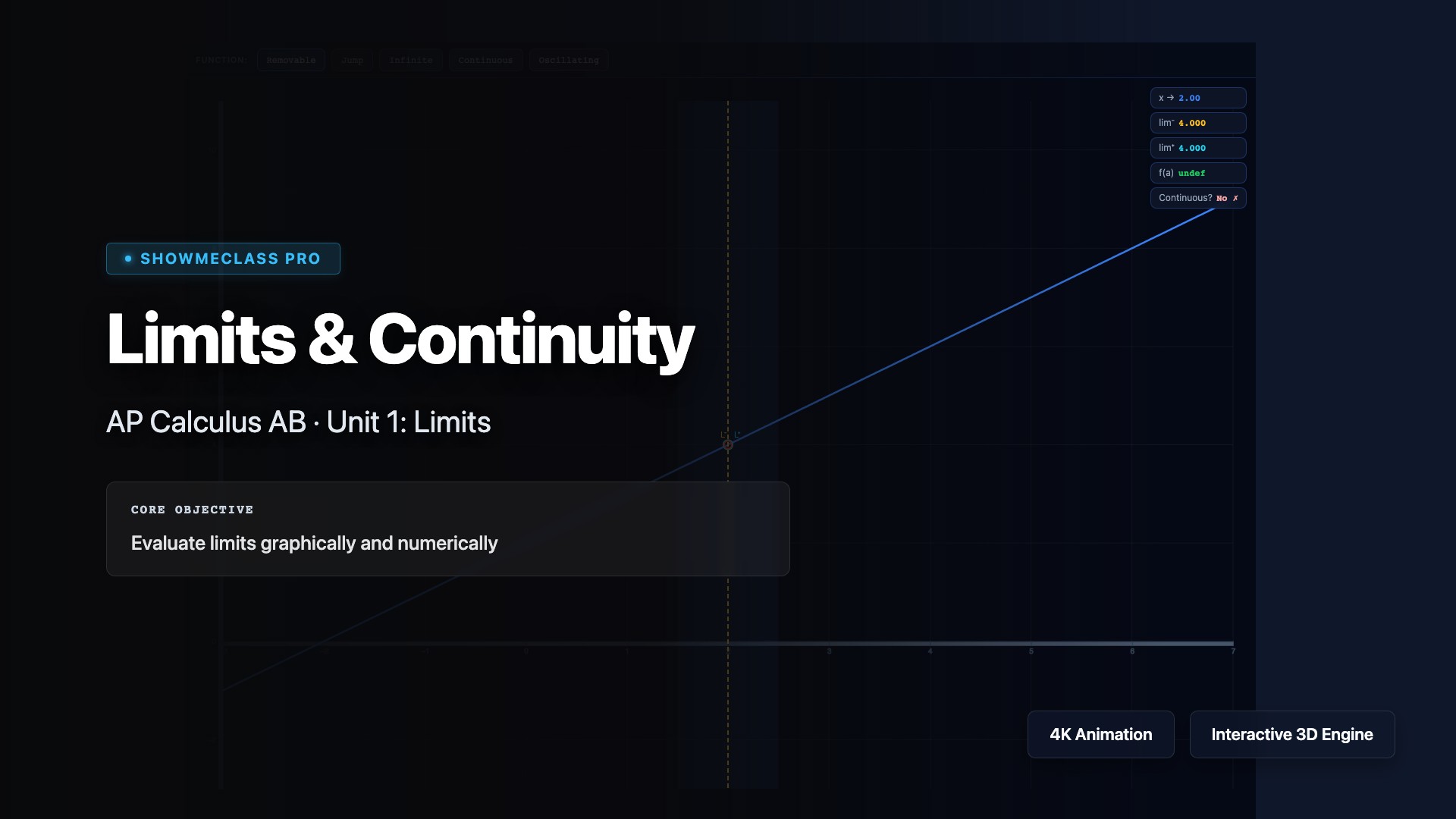
Limits & Continuity
Explore the foundational concepts of limits and continuity that underpin all of calculus. Visualize one-sided limits, two-sided limits, and limits at infinity. Understand the three conditions for continuity at a point: f(c) is defined, lim[x→c] f(x) exists, and lim[x→c] f(x) = f(c). Practice identifying discontinuities (removable, jump, and infinite) and applying limit laws to evaluate complex expressions.
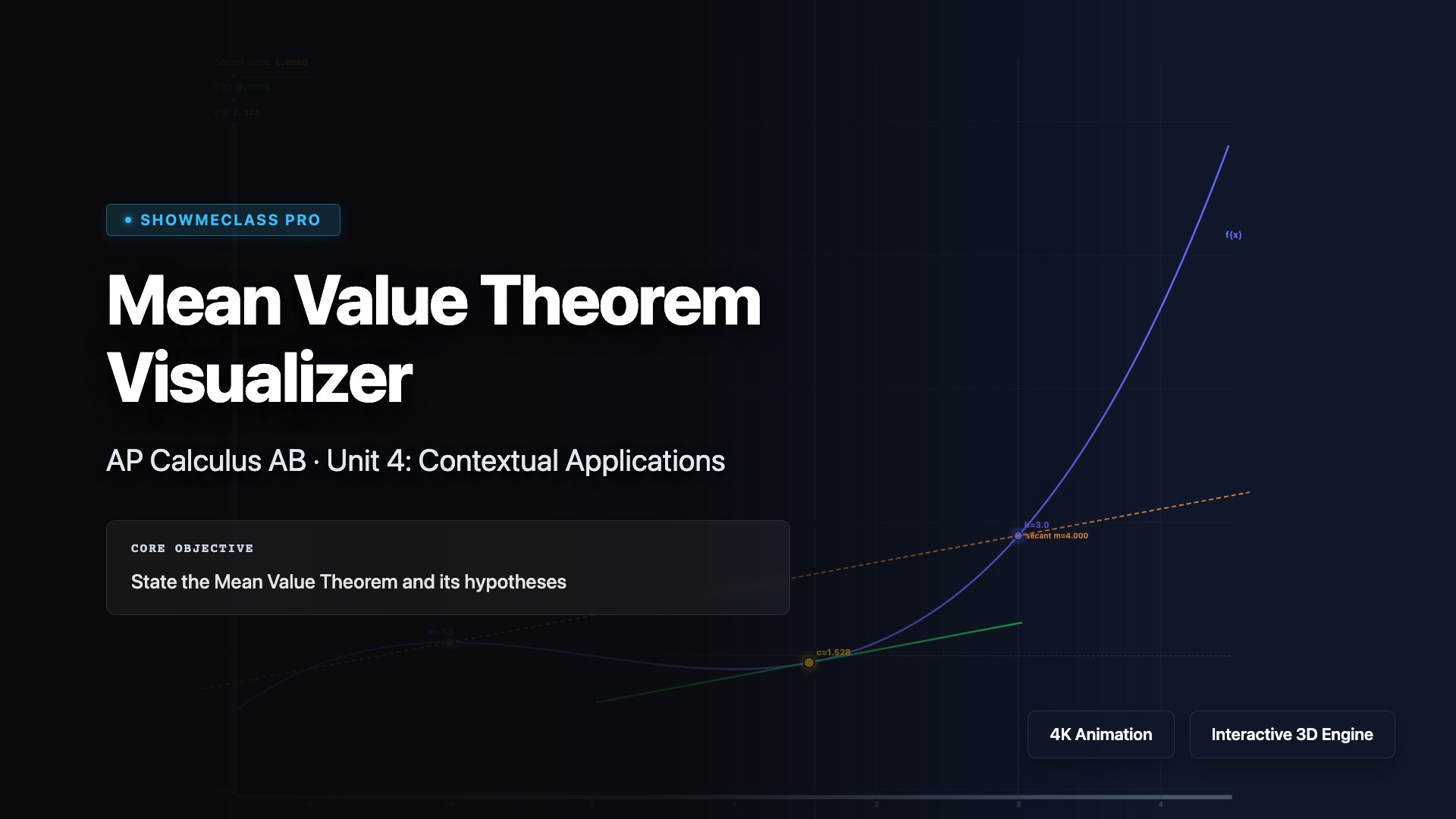
Mean Value Theorem Visualizer
Visualize the Mean Value Theorem (MVT), which guarantees that for a continuous and differentiable function on [a,b], there exists at least one point c where f'(c) = (f(b)-f(a))/(b-a). Explore how the instantaneous rate of change equals the average rate of change at some interior point. Understand MVT's applications in proving inequalities, analyzing motion, and establishing fundamental results like the constant difference theorem.
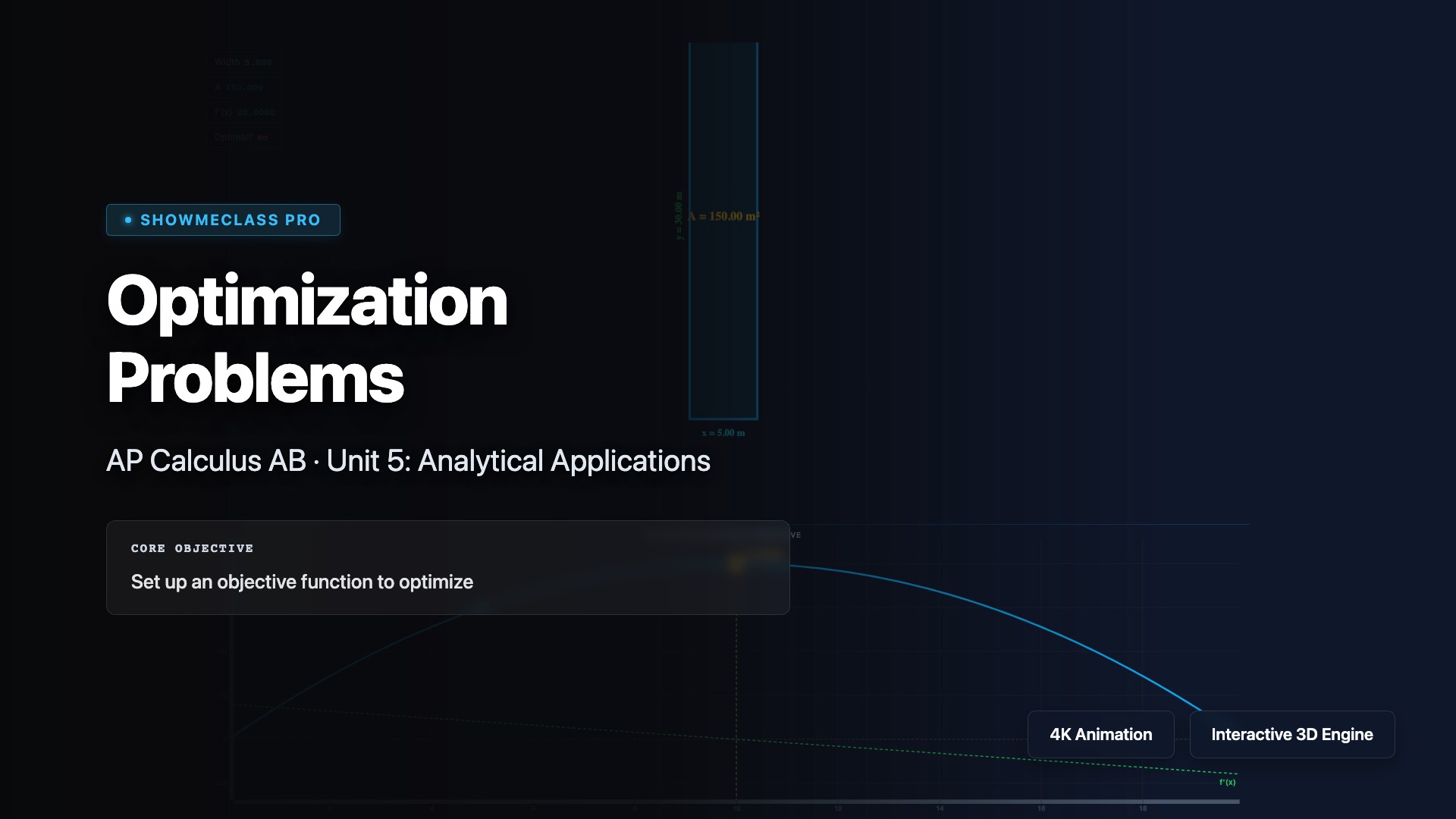
Optimization Problems
Solve optimization problems by finding absolute and relative extrema using calculus techniques. Learn to identify constraints, write objective functions, take derivatives, find critical points using f'(x) = 0, and apply the first or second derivative test. Explore real-world applications including maximizing area, minimizing cost, optimizing volume, and finding shortest distances in geometry, physics, and economics.
Related Rates Visualizer
Solve related rates problems where multiple quantities change with respect to time and are connected by an equation. Use implicit differentiation with respect to time to find how one rate of change relates to another. Visualize classic scenarios like ladder sliding down walls, water filling conical tanks, expanding circles, and moving shadows, applying the chain rule to connect dy/dt, dx/dt, and geometric relationships.
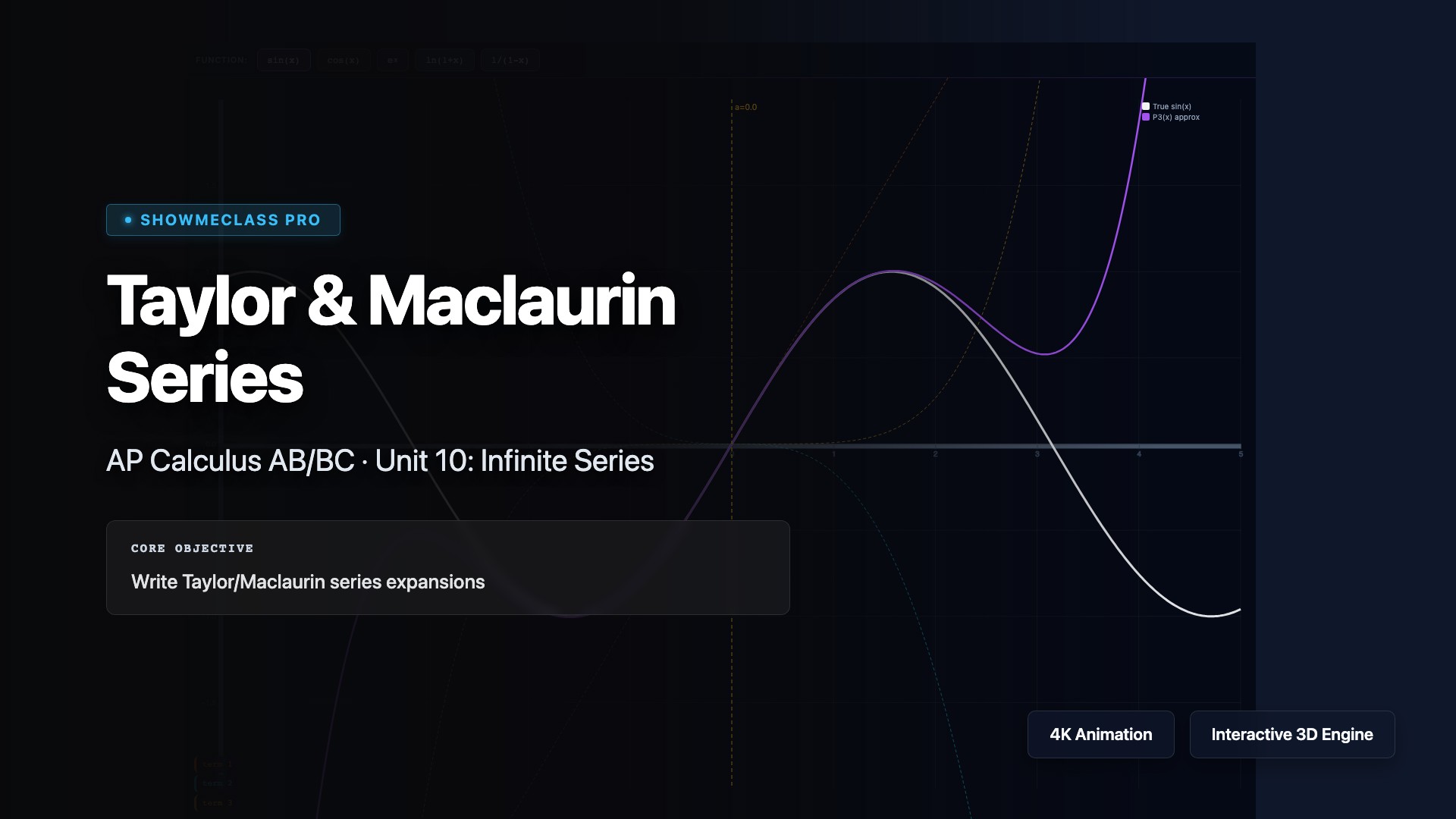
Taylor Series
Explore Taylor and Maclaurin series, which approximate functions as infinite polynomials using derivatives at a single point. Visualize how f(x) ≈ f(a) + f'(a)(x-a) + f''(a)(x-a)²/2! + ... converges to the original function. Understand how adding more terms improves accuracy, and learn common series for e^x, sin(x), cos(x), and ln(1+x). Practice finding intervals of convergence and estimating error bounds.
Volumes w/ Known Cross Sections
Calculate volumes of solids with known cross-sectional shapes perpendicular to an axis using integration. Visualize how V = ∫[a to b] A(x)dx sums infinitely many cross-sectional areas—squares, rectangles, semicircles, equilateral triangles, and isosceles right triangles. Understand how the base region determines the limits of integration and how the cross-section shape determines the area function A(x).