
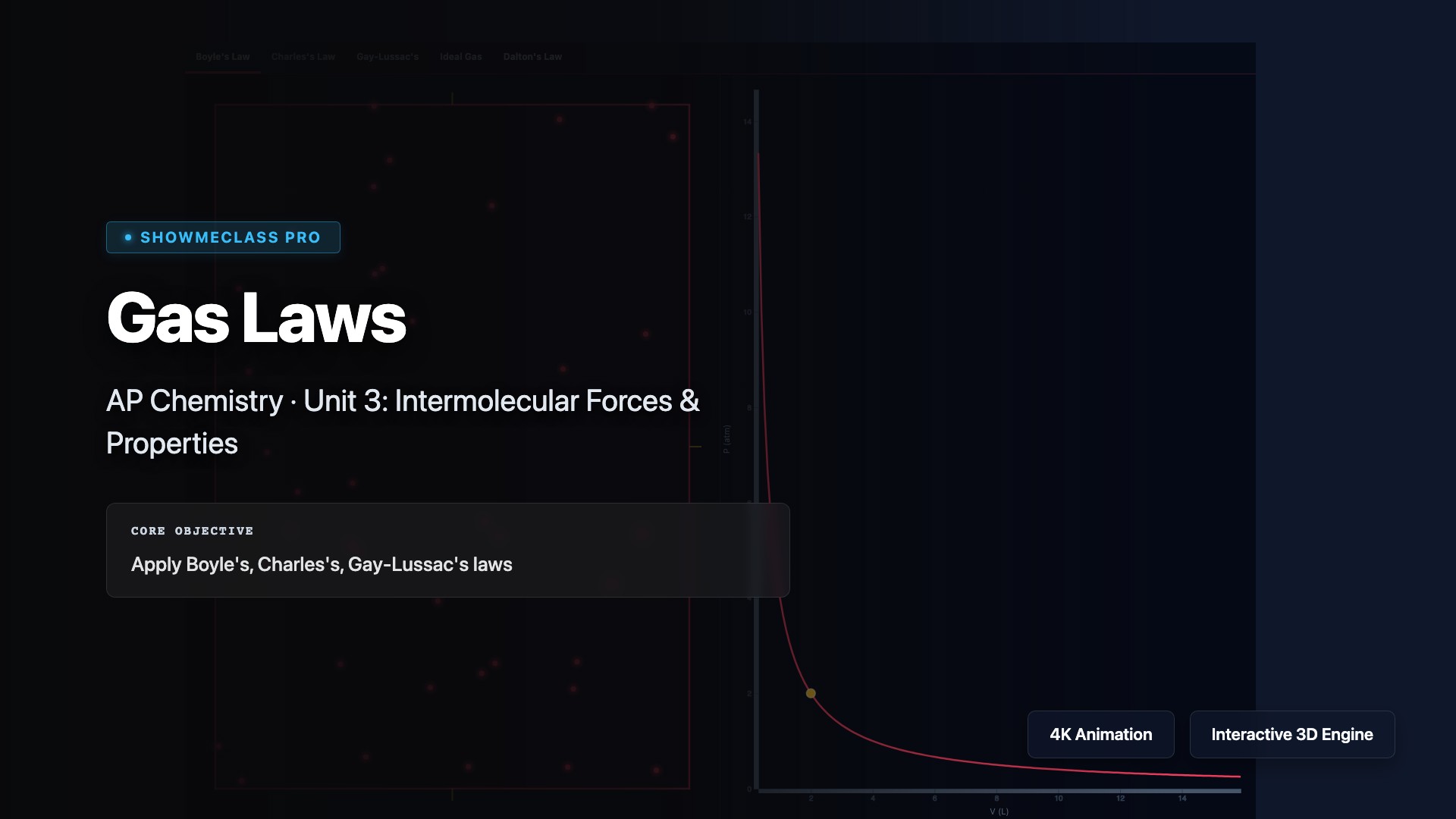
Gas Laws
Explore the fundamental gas laws that describe relationships between pressure, volume, temperature, and amount of gas. Visualize Boyle's Law (P₁V₁ = P₂V₂), Charles's Law (V₁/T₁ = V₂/T₂), Gay-Lussac's Law (P₁/T₁ = P₂/T₂), Avogadro's Law (V₁/n₁ = V₂/n₂), and the Combined Gas Law. Understand how these individual laws combine to form the Ideal Gas Law PV = nRT.

Electron Configuration
Build electron configurations for atoms and ions using the Aufbau principle, Hund's rule, and the Pauli exclusion principle. Visualize how electrons fill orbitals in order of increasing energy (1s, 2s, 2p, 3s, 3p, 4s, 3d...), understand noble gas notation shortcuts, and identify valence electrons. Explore exceptions like chromium and copper, and connect electron configuration to periodic trends and chemical reactivity.
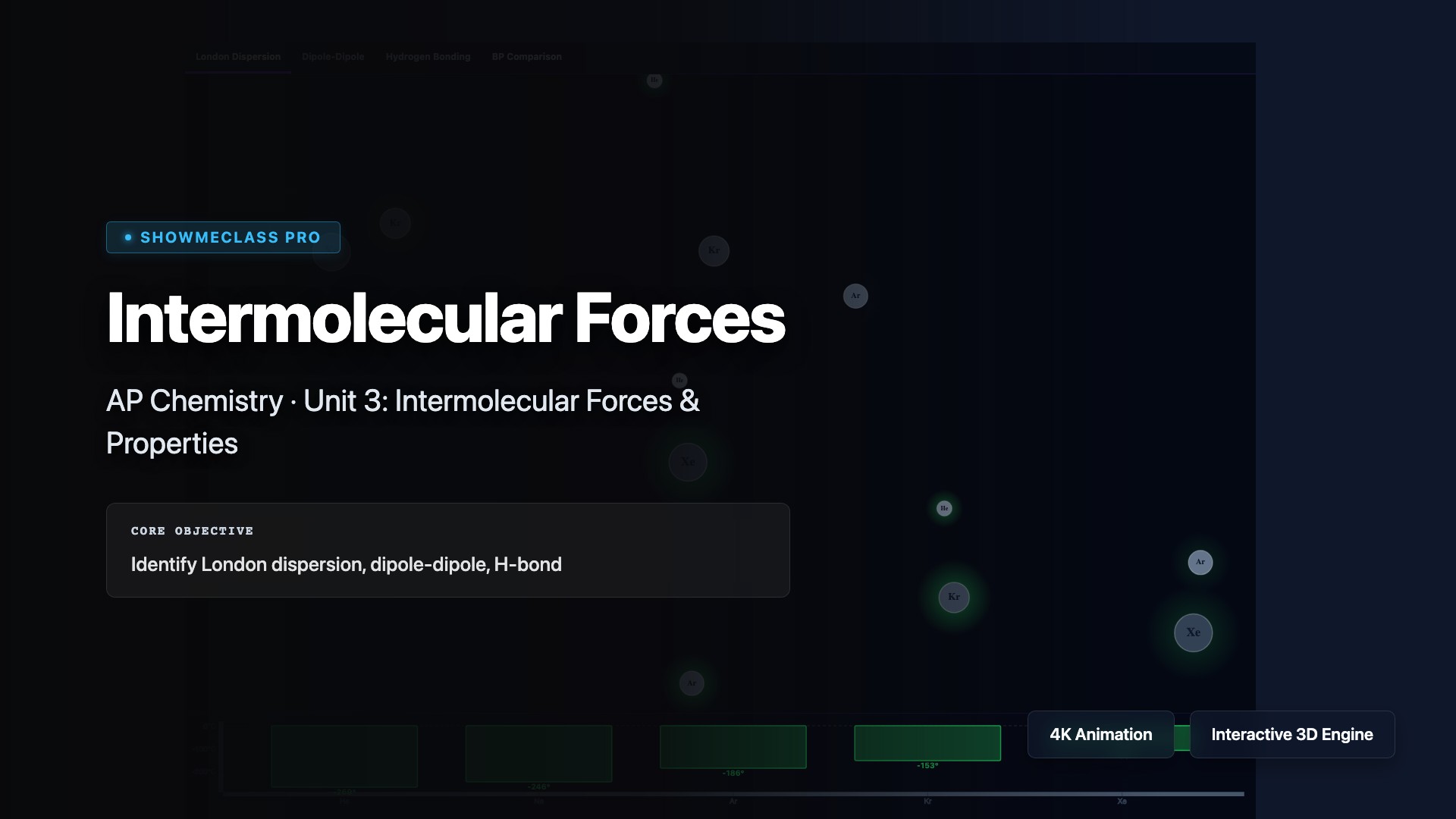
Intermolecular Forces
Explore the attractive forces between molecules that determine physical properties like boiling point, melting point, and solubility. Compare London dispersion forces (weakest, present in all molecules), dipole-dipole interactions (polar molecules), and hydrogen bonding (strongest IMF, requires H bonded to N, O, or F). Understand how molecular structure, polarity, and molecular weight affect IMF strength and predict relative boiling points.
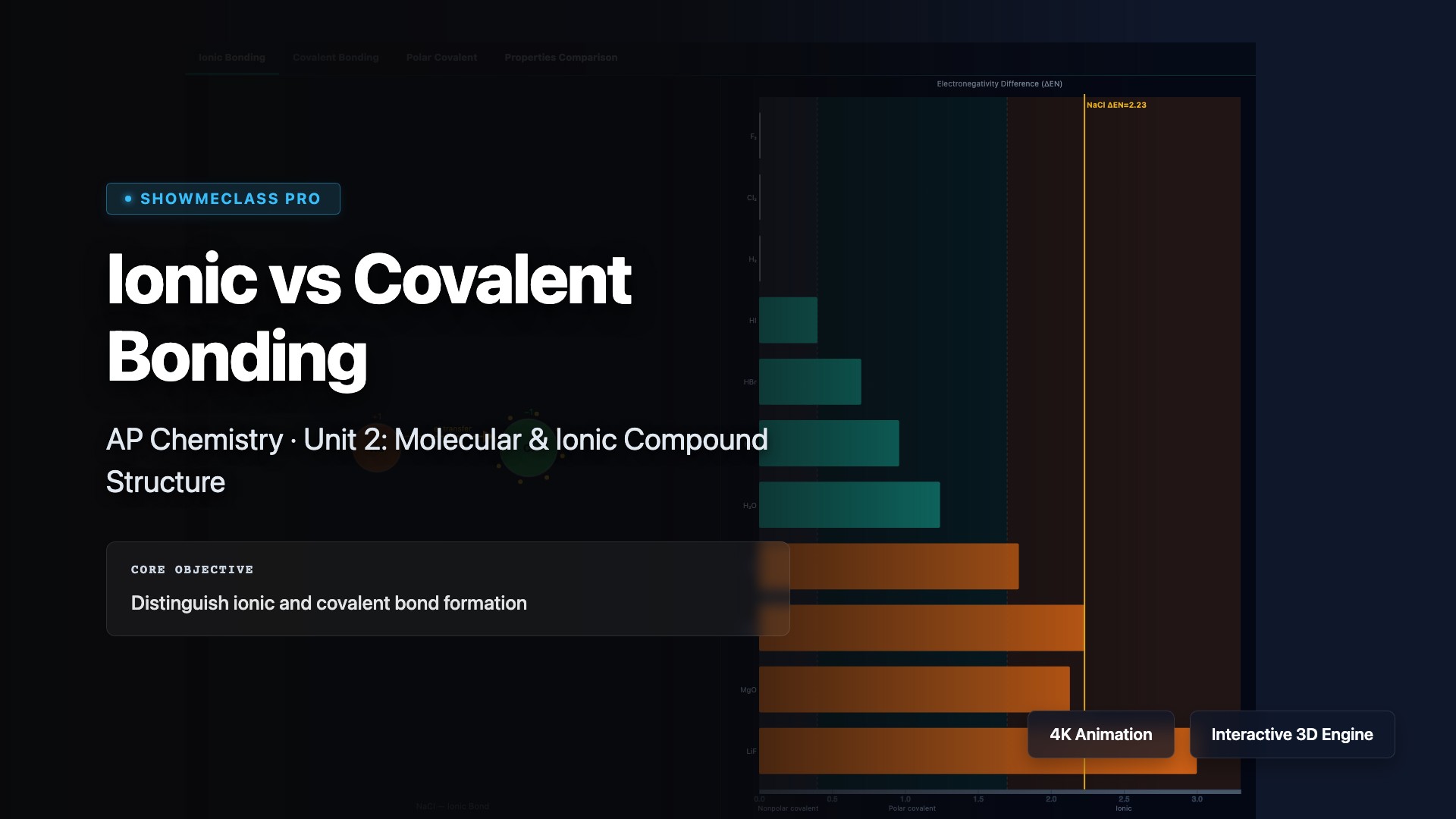
Ionic vs Covalent Bonding
Compare ionic bonding (electron transfer between metals and nonmetals forming electrostatic attractions) with covalent bonding (electron sharing between nonmetals). Visualize how electronegativity differences determine bond type: ΔEN > 1.7 indicates ionic, ΔEN < 0.4 indicates nonpolar covalent, and intermediate values indicate polar covalent bonds. Understand how bond type affects properties like melting point, electrical conductivity, and solubility.