Brain Hemispheres & Lobes
Explore the Cerebral Cortex. Interactive neuroanatomy highlighting the Frontal, Parietal, Occipital, and Temporal lobes, along with the Cerebellum and Brainstem.
THE STRUCTURE OF THE HUMAN BRAIN
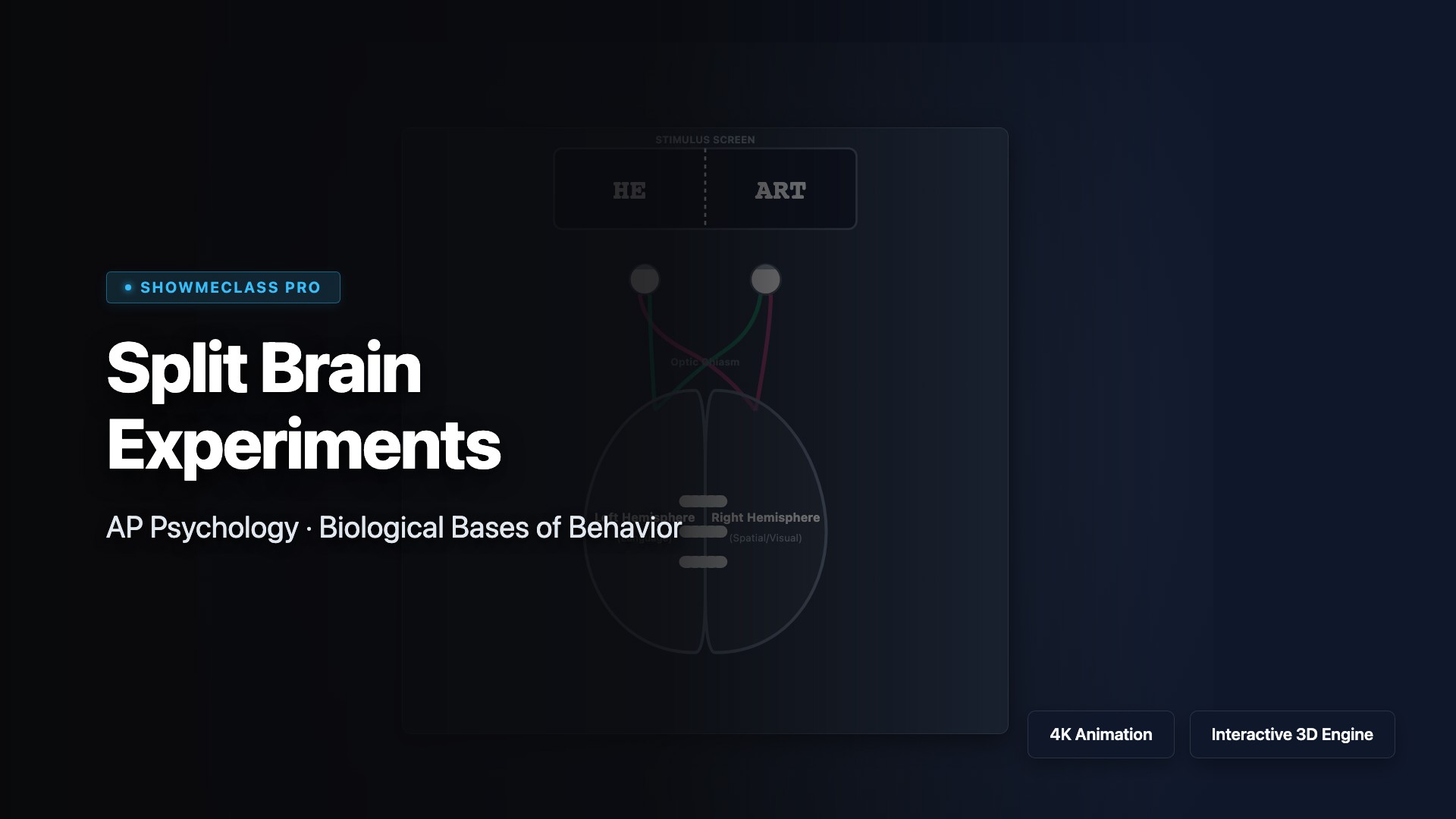
The human brain is the most complex organ in the body, serving as the center of the nervous system. In AP Psychology, students must master the functional neuroanatomy of the cerebral cortex, the limbic system, and the brainstem. The brain is divided into two hemispheres (connected by the corpus callosum) and four distinct lobes: Frontal, Parietal, Occipital, and Temporal—each responsible for specialized cognitive and physical processes.
THE FOUR LOBES AND THEIR FUNCTIONS
1. **Frontal Lobe**: Executive functions, planning, personality, and the motor cortex. 2. **Parietal Lobe**: Processing sensory information (touch, temperature, pain) via the somatosensory cortex. 3. **Occipital Lobe**: Visual processing; home to the primary visual cortex. 4. **Temporal Lobe**: Auditory processing and language comprehension (Wernicke's area).
HOW TO USE THIS VISUALIZATION
1. **Rotate the 3D Model**: Click and drag the brain to view it from any angle (superior, inferior, lateral, or medial). 2. **Isolate Structures**: Click on a specific lobe or structure (like the Cerebellum or Amygdala) to highlight it and see its primary functions and AP exam 'must-knows'. 3. **Cross-Section View**: Use the 'Slicing' tool to see internal structures like the Thalamus and Hippocampus. 4. **Neural Pathways**: Toggle the 'Signal Flow' to see how sensory information travels from the periphery to the primary processing centers.
AP EXAM CONNECTION
Unit: Unit 2: Biological Bases of Behavior (Topic 2.6)
Learning Objective: IST-4.A
COMMON MISCONCEPTIONS
- Thinking we only use 10% of our brains (we use virtually every part, just not all at once).
- Confusing Broca's Area (production) with Wernicke's Area (comprehension).
- Assuming "left-brained" vs "right-brained" personalities are scientifically valid (functions are lateralized, but hemispheres work together).
KEY TAKEAWAYS
- The cerebral cortex is divided into four lobes with specialized functions.
- The limbic system (Hippocampus, Amygdala, Hypothalamus) handles emotion and memory.
- The brainstem controls basic survival functions like breathing and heart rate.
- Neuroplasticity allows the brain to reorganize itself after damage.