
Showing 4 results
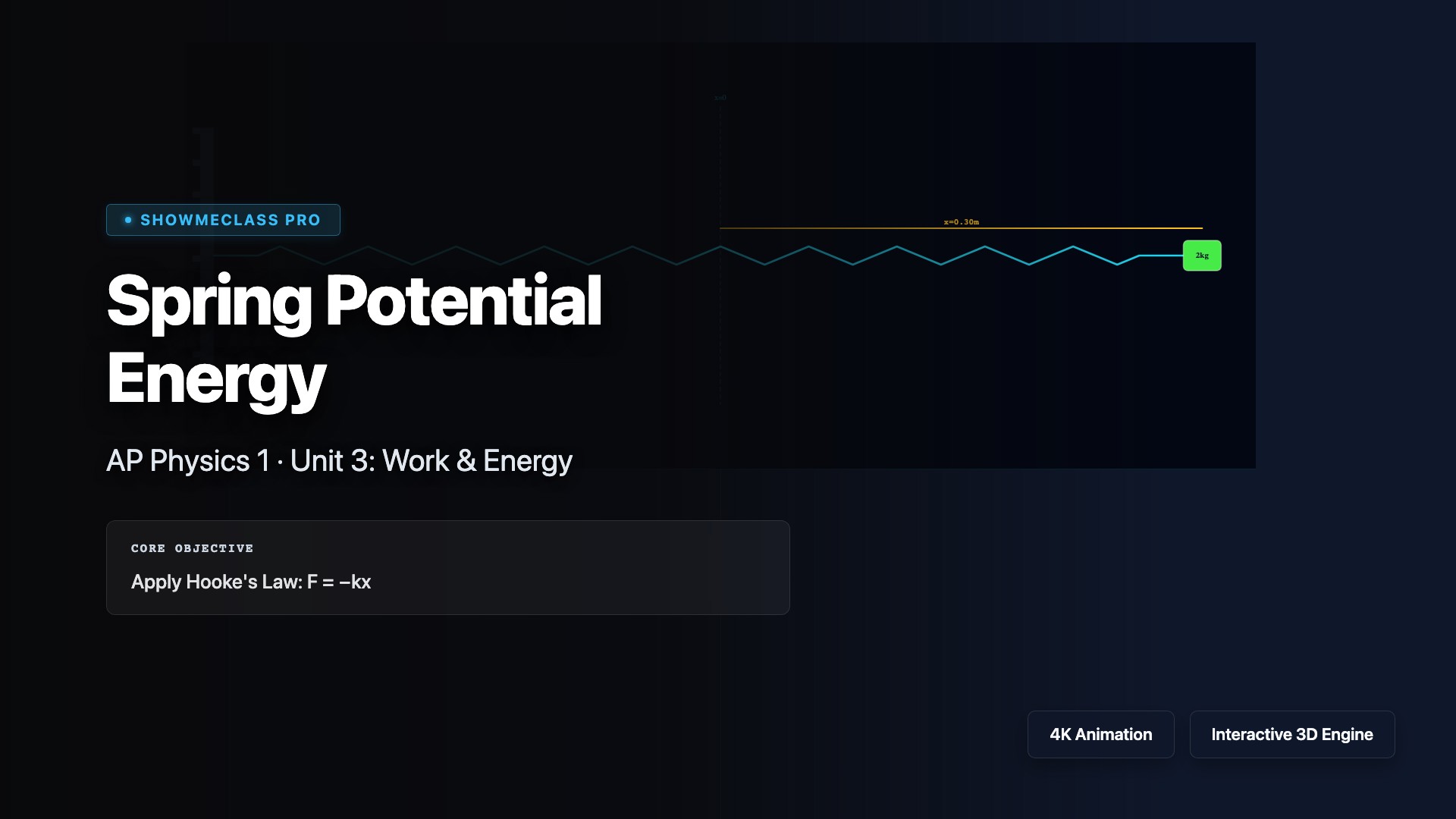
Spring Potential Energy
Explore elastic potential energy stored in springs using Hooke's Law (F = -kx) and the energy formula PEspring = ½kx², where k is the spring constant and x is displacement from equilibrium. Visualize how compressing or stretching a spring stores energy that can be converted to kinetic energy. Apply conservation of energy to spring-mass systems, understand the relationship between spring stiffness and stored energy, and solve problems involving springs in toys, shock absorbers, and oscillating systems.

Velocity
Analyze velocity-time graphs to understand motion characteristics. Learn that the slope of a v-t graph gives acceleration, and the area under the curve represents displacement. Practice interpreting constant velocity (horizontal line), constant acceleration (straight slope), and changing acceleration (curved line). Understand how positive/negative slopes indicate speeding up/slowing down, and how the graph connects to position-time and acceleration-time representations of motion.

Wave Interference & Superposition
Interactive 3D ripple tank for studying mechanical wave interference. Manipulate wavelength, frequency, and source distance to observe nodal lines and superposition.

Work
Explore the work-energy theorem stating that net work done on an object equals its change in kinetic energy (Wnet = ΔKE). Understand that work is force times displacement in the direction of force (W = Fd cos θ), measured in joules. Visualize how positive work increases kinetic energy, negative work decreases it, and perpendicular forces do zero work. Apply the theorem to analyze motion with varying forces, friction, and gravitational effects.