VSEPR Molecular Geometry
Explore 3D molecular geometries for common electron-domain configurations. Rotate and inspect tetrahedral, trigonal planar, linear, octahedral, and bent structures. Understand how lone pairs distort ideal bond angles.

Explore 3D molecular geometries for common electron-domain configurations. Rotate and inspect tetrahedral, trigonal planar, linear, octahedral, and bent structures. Understand how lone pairs distort ideal bond angles.
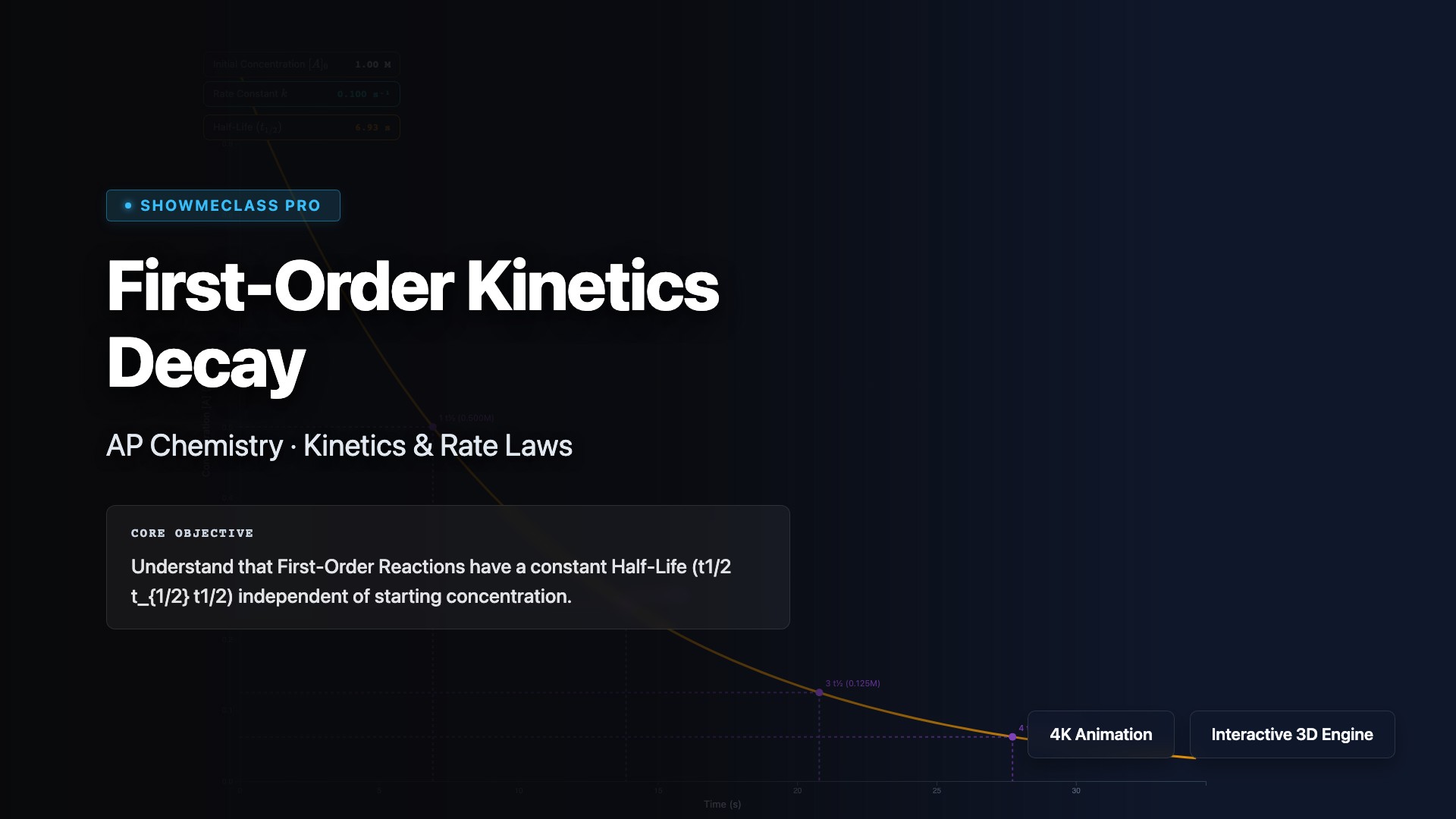
Analyze first-order reactions where the rate depends linearly on one reactant concentration: rate = k[A]. Visualize exponential decay using the integrated rate law ln[A]t = ln[A]₀ - kt, and understand that first-order reactions have constant half-life t₁/₂ = 0.693/k independent of initial concentration. Explore applications in radioactive decay, drug metabolism, and chemical decomposition reactions.
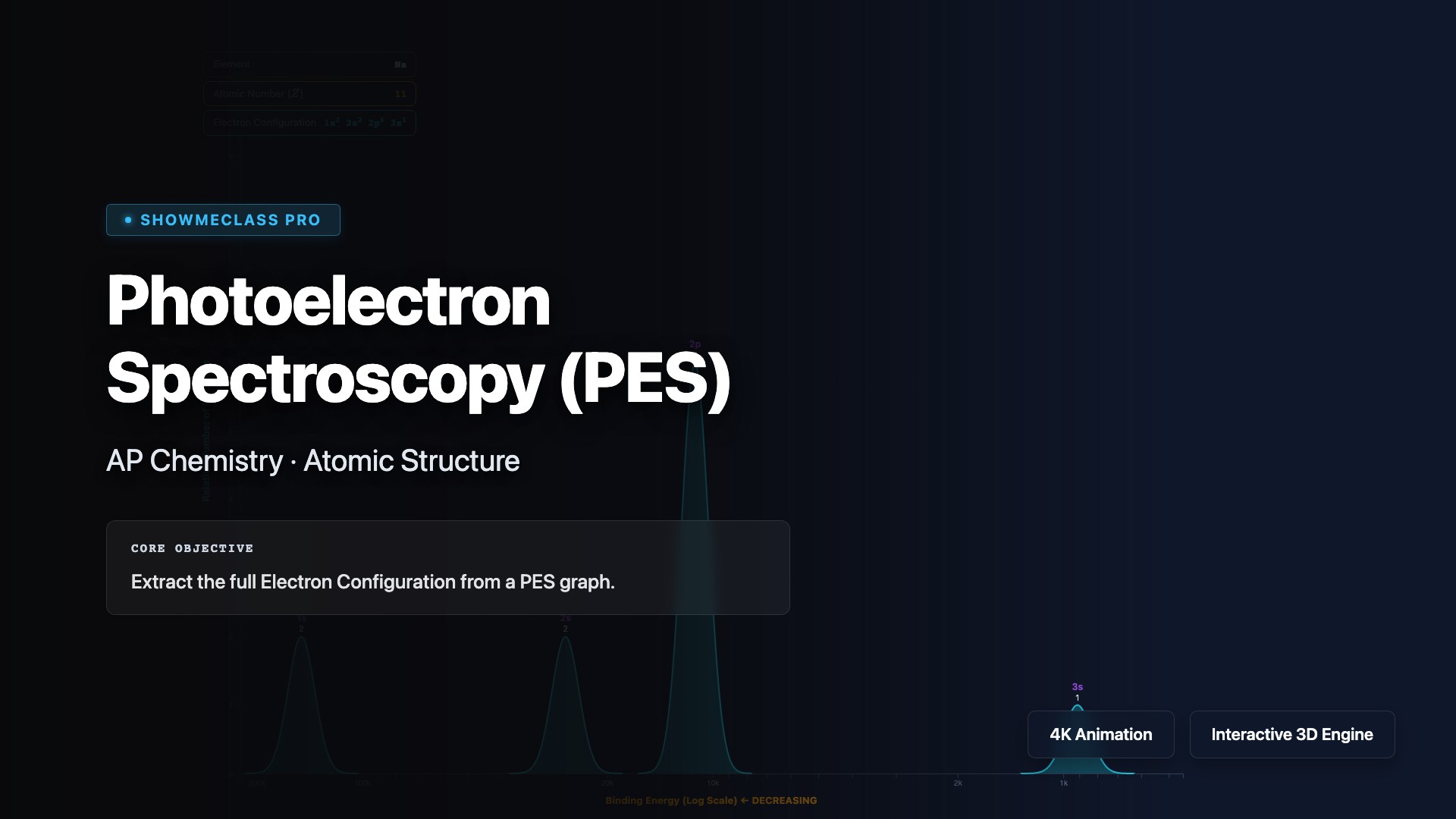
Interpret photoelectron spectroscopy (PES) data to determine electron configuration and relative energies of electrons in different orbitals. Analyze PES spectra where peak position indicates binding energy (related to Coulomb's law and effective nuclear charge) and peak height represents the number of electrons. Practice identifying elements from their PES spectra and understanding how core versus valence electrons produce distinct peaks.
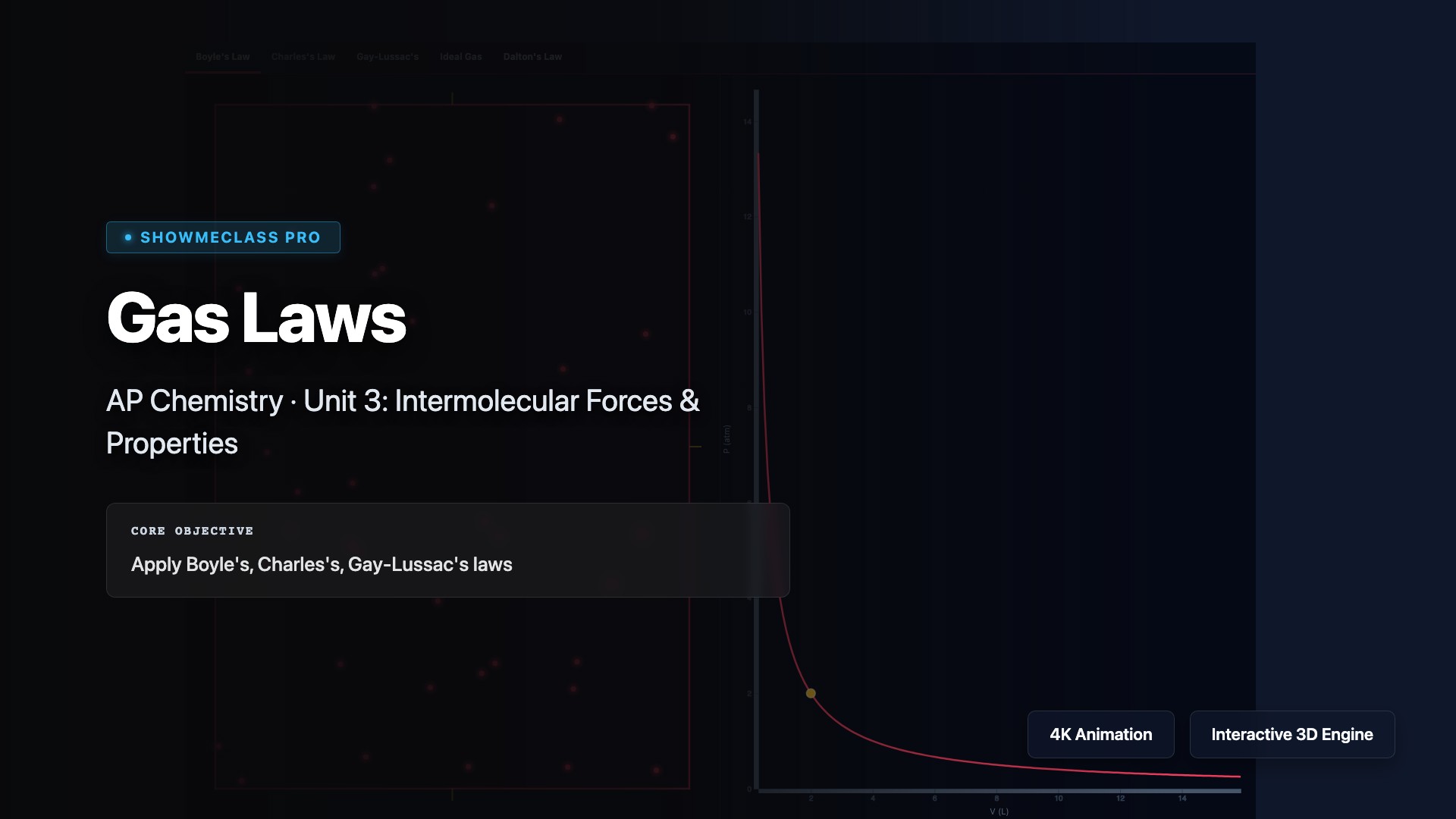
Explore the fundamental gas laws that describe relationships between pressure, volume, temperature, and amount of gas. Visualize Boyle's Law (P₁V₁ = P₂V₂), Charles's Law (V₁/T₁ = V₂/T₂), Gay-Lussac's Law (P₁/T₁ = P₂/T₂), Avogadro's Law (V₁/n₁ = V₂/n₂), and the Combined Gas Law. Understand how these individual laws combine to form the Ideal Gas Law PV = nRT.
Build electron configurations for atoms and ions using the Aufbau principle, Hund's rule, and the Pauli exclusion principle. Visualize how electrons fill orbitals in order of increasing energy (1s, 2s, 2p, 3s, 3p, 4s, 3d...), understand noble gas notation shortcuts, and identify valence electrons. Explore exceptions like chromium and copper, and connect electron configuration to periodic trends and chemical reactivity.