Entropy in Heat Engines
Visualize the 2nd Law of Thermodynamics. Build reversible Carnot engines and irreversible real engines to track the exact entropy changes in the hot reservoir, cold reservoir, and the universe.
WHAT IS ENTROPY?
Entropy () is a measure of the disorder or randomness of a system. The **Second Law of Thermodynamics** states that the total entropy of an isolated system can never decrease over time; it can only remain constant or increase. In terms of heat engines, this means that it is impossible to convert heat entirely into work—some energy must always be rejected to a cold reservoir, increasing the entropy of the universe.
HEAT ENGINES & EFFICIENCY
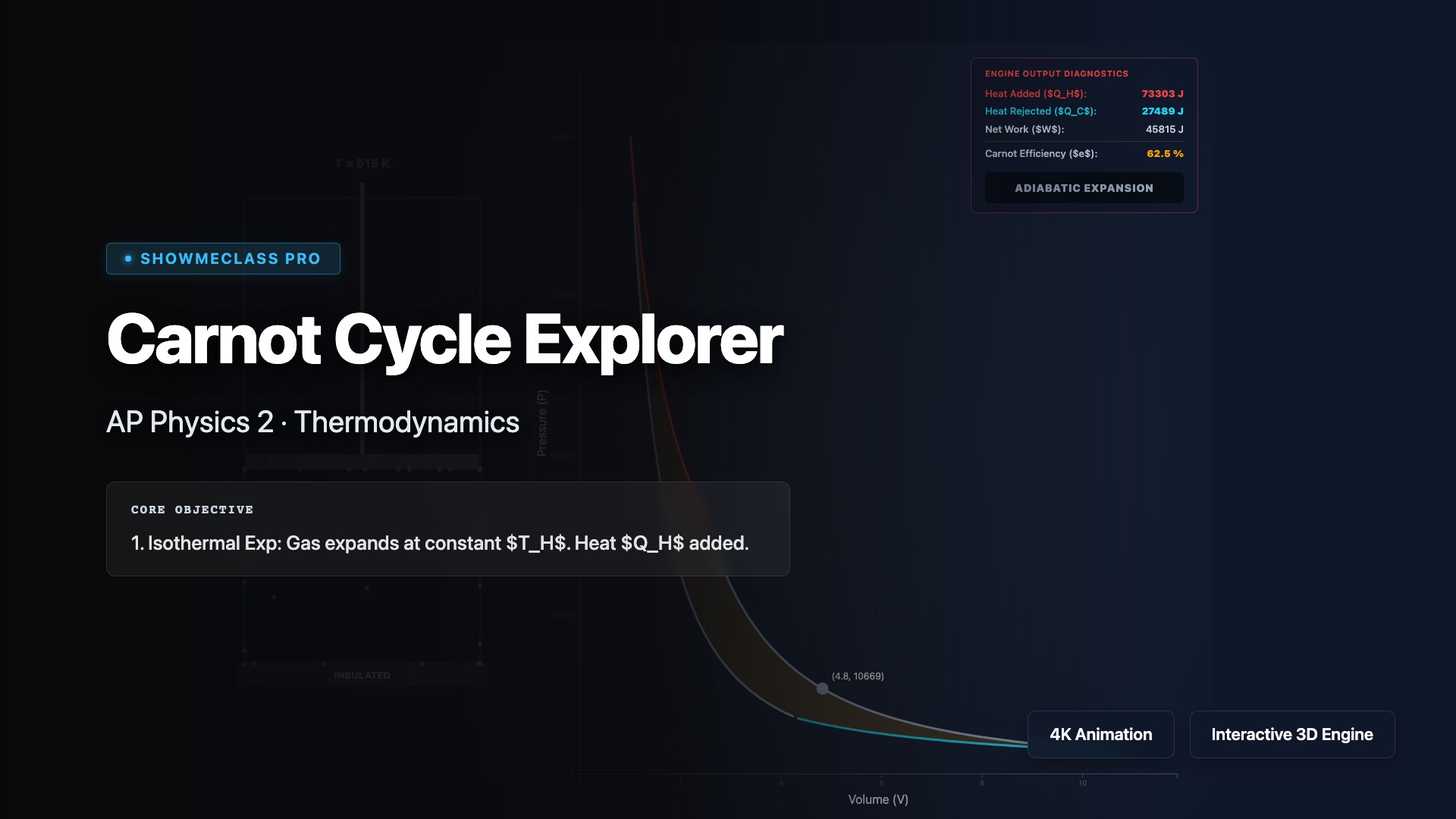
A heat engine is a device that takes heat from a hot source, converts part of it into useful work, and exhausts the remainder to a cold sink. The efficiency is the ratio of work done to the heat input. Entropy explains why 100% efficiency is physically impossible: even an ideal "Carnot" engine produces zero net change in universe entropy, while all real engines increase it.
HOW TO USE THIS VISUALIZATION
1. **Run the Engine**: Watch heat flow from hot to cold. Observe how much is converted to work. 2. **Increase Friction**: Add irreversibilities and watch the "Entropy Generated" meter rise while efficiency drops. 3. **Isothermal vs Adiabatic**: Observe how entropy stays constant in an ideal adiabatic process (isentropic) but changes during heat exchange.
CORE FORMULAS
AP EXAM CONNECTION
Unit: Unit 2: Thermodynamics (Topic 2.2)
Learning Objective: ENE-1.D
COMMON MISCONCEPTIONS
- Confusing entropy with energy (energy is conserved, entropy is not).
- Thinking "disorder" only means physical messiness (it refers to energy distributions).
- Forgetting that the 2nd Law applies to the *total* entropy of the universe.
KEY TAKEAWAYS
- Total entropy of the universe always increases.
- Heat engines must reject heat to work.
- Entropy change is heat divided by temperature.
PRACTICE QUESTIONS
Q1 (QUANTITATIVE): 1000 J of heat flows from a reservoir at 500 K to one at 250 K. What is the total change in entropy of the universe?
Show Answer & Explanation
Answer: +2 J/K
Explanation: . . .
Q2 (CONCEPTUAL): Can the entropy of a system ever decrease?
Show Answer & Explanation
Answer: Yes, if entropy elsewhere increases more.
Explanation: Local entropy can decrease (e.g., water freezing), but only if heat is released to surroundings, increasing their entropy by a larger amount.
DEEP DIVE: RELATED CONCEPTS
The Carnot cycle is a theoretical thermodynamic cycle that represents the maximum possible efficienc...
CONSTANT PRESSURE AND CONSTANT VOLUMEThermodynamic processes are often categorized by the physical properties they keep constant. An **is...
WHAT IS THERMAL CONDUCTIVITY?Thermal conductivity is a measure of a material's ability to conduct heat. Heat transfer through con...