
Showing 12 results
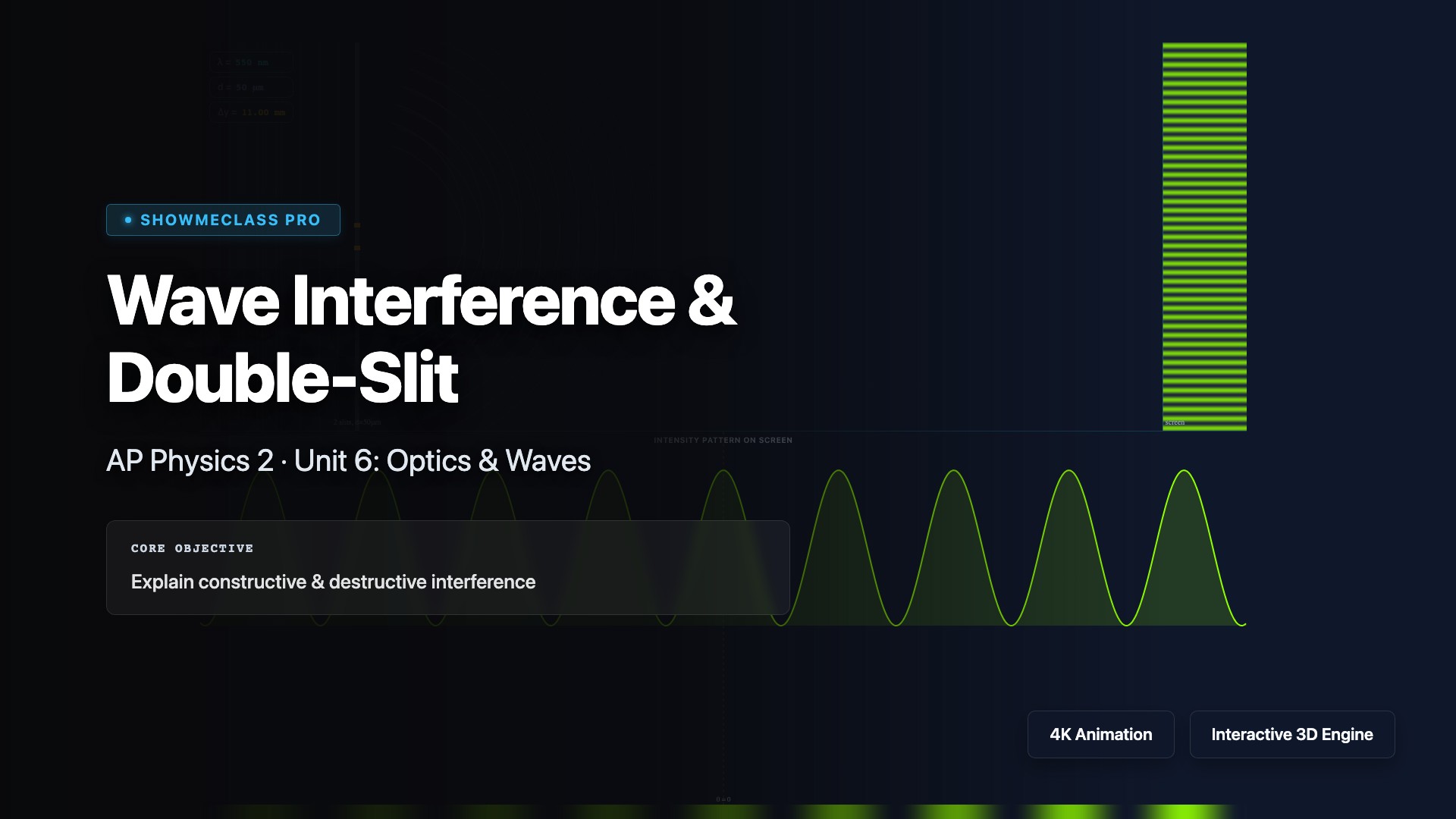
Wave Interference & Superposition
Interactive 3D ripple tank for studying mechanical wave interference. Manipulate wavelength, frequency, and source distance to observe nodal lines and superposition.
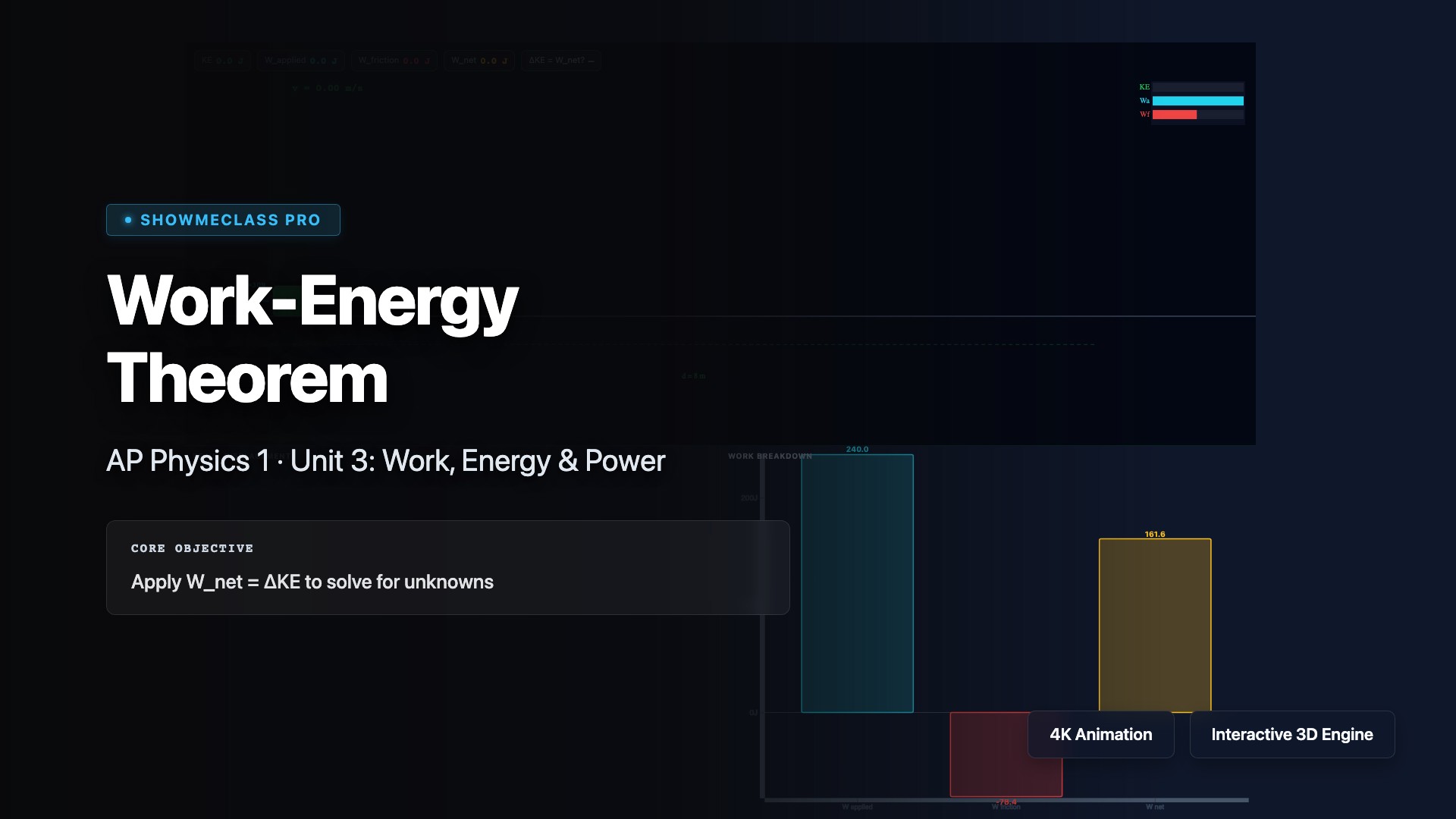
Work
Explore the work-energy theorem stating that net work done on an object equals its change in kinetic energy (Wnet = ΔKE). Understand that work is force times displacement in the direction of force (W = Fd cos θ), measured in joules. Visualize how positive work increases kinetic energy, negative work decreases it, and perpendicular forces do zero work. Apply the theorem to analyze motion with varying forces, friction, and gravitational effects.
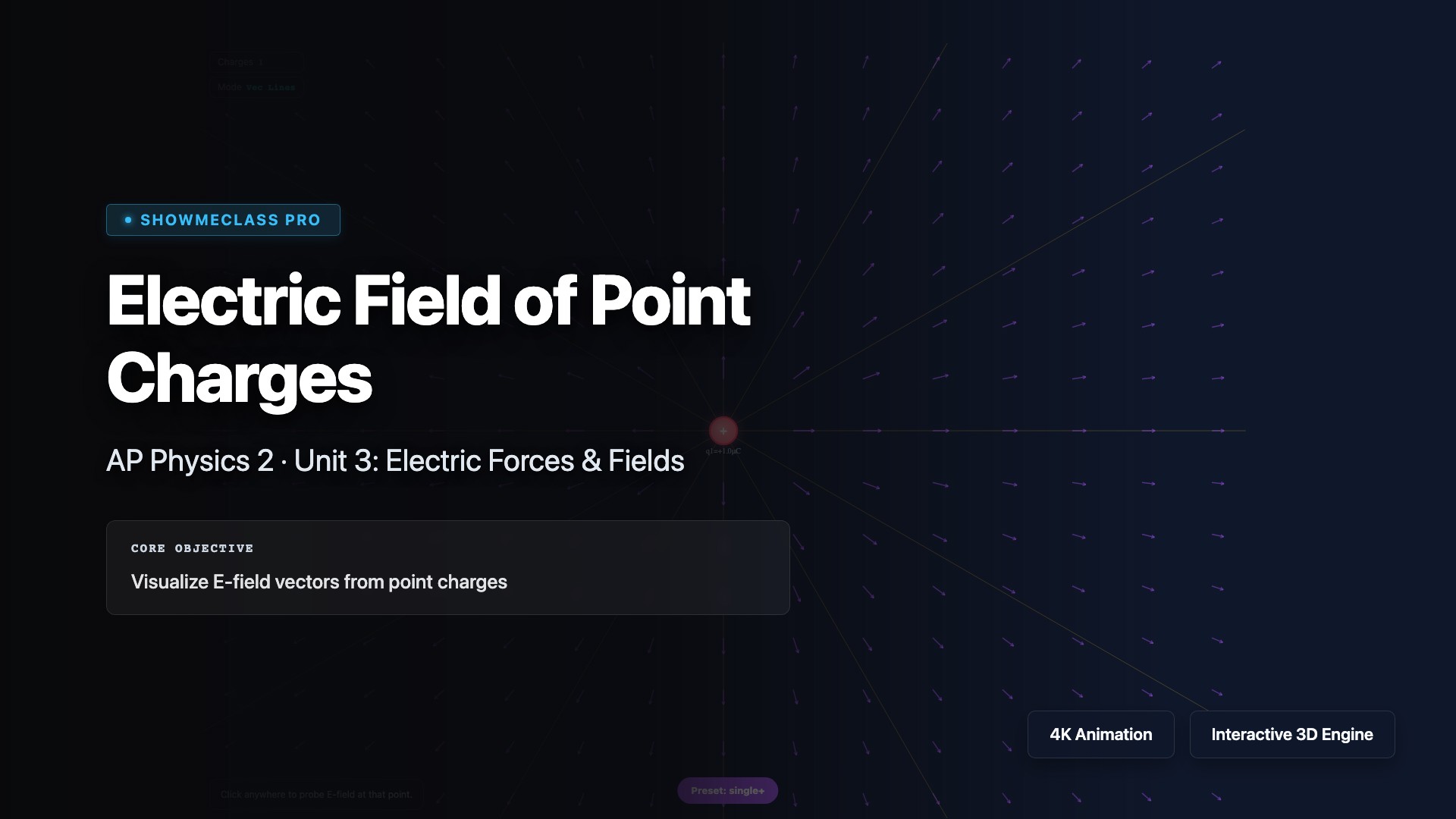
Electric Field of Point Charges
Visualize electric fields created by point charges using field lines radiating outward from positive charges and inward toward negative charges. Calculate electric field strength using E = kQ/r² and apply the superposition principle to find net fields from multiple charges. Understand that field line density indicates field strength, lines never cross, and the electric field direction shows the force a positive test charge would experience at each point in space.

Electric Potential & Equipotentials
Explore electric potential (voltage) as the electric potential energy per unit charge, measured in volts. Calculate potential from point charges using V = kQ/r and understand that equipotential lines connect points of equal potential, always perpendicular to electric field lines. Visualize how positive charges move from high to low potential (downhill), work is done moving charges against the field, and the relationship ΔV = -∫E·ds connects potential difference to electric field.
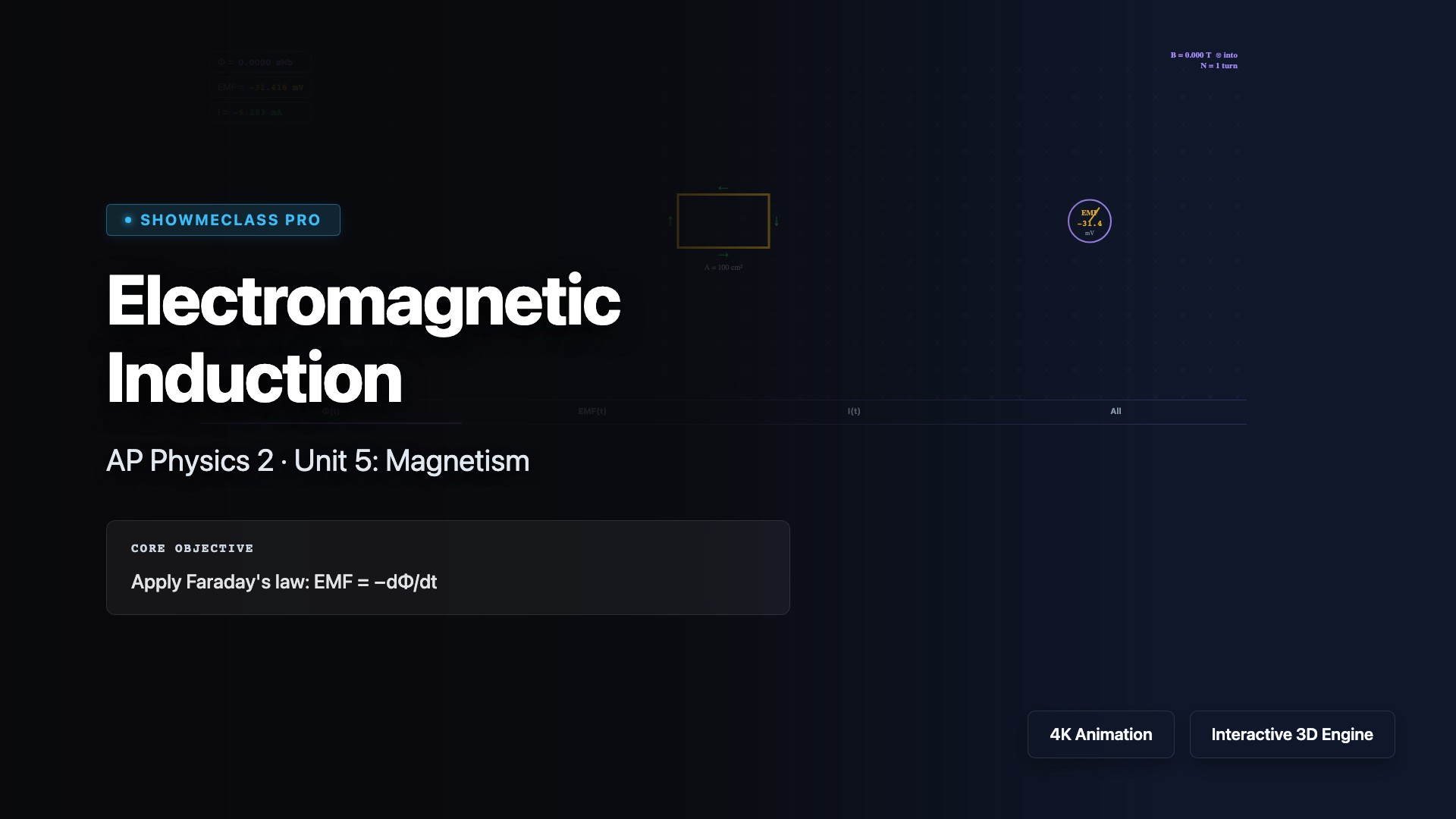
Electromagnetic Induction
Explore Faraday's law of electromagnetic induction stating that changing magnetic flux through a loop induces an electromotive force (EMF) given by ε = -dΦB/dt. Understand Lenz's law: the induced current creates a magnetic field opposing the flux change. Visualize how moving magnets near coils, changing current in nearby circuits, or rotating loops in magnetic fields generate electricity. Apply these principles to generators, transformers, and induction cooktops.
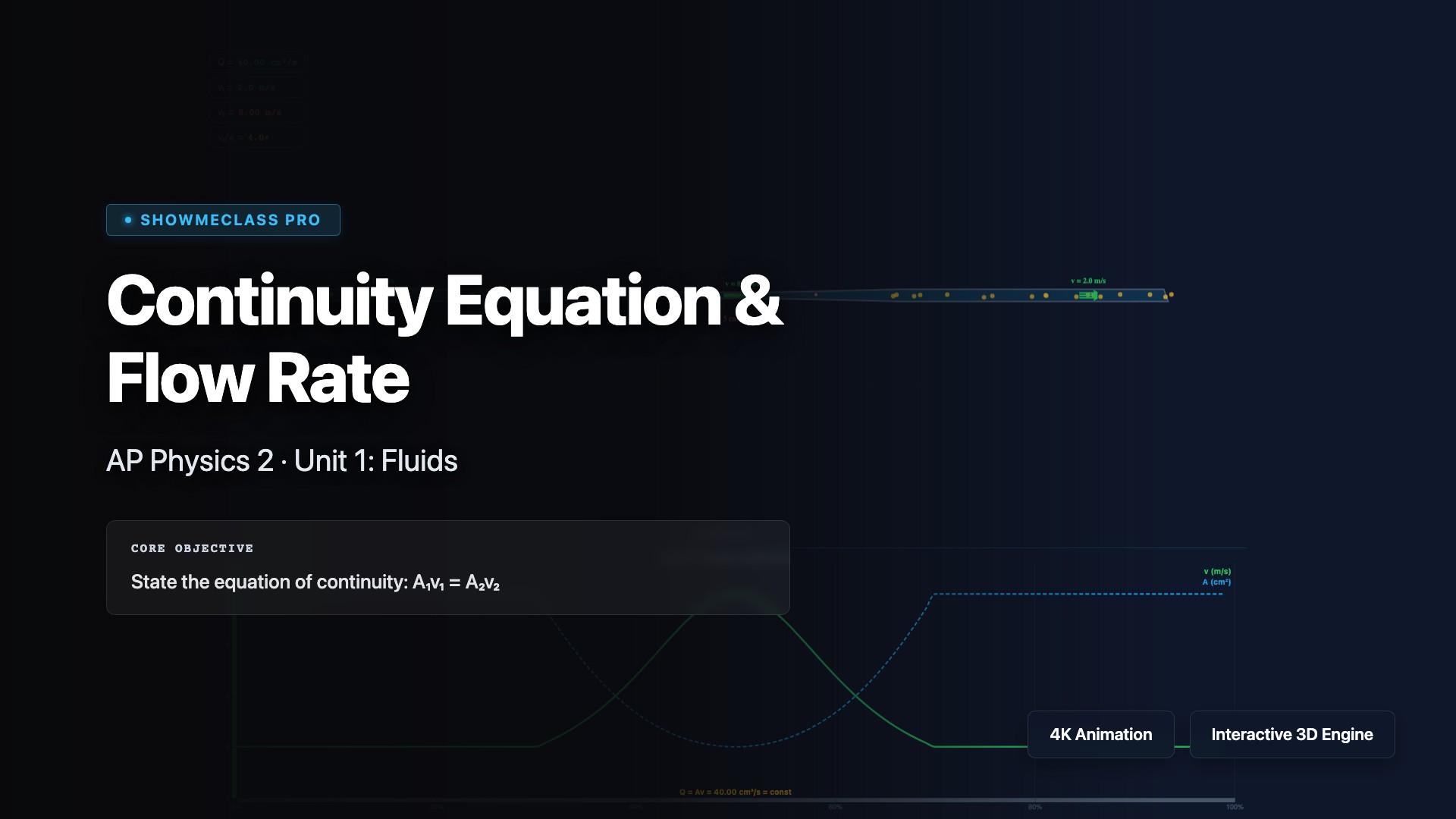
Continuity Equation & Flow Rate
Explore the continuity equation for incompressible fluids stating that mass flow rate is constant: A₁v₁ = A₂v₂, where A is cross-sectional area and v is fluid velocity. Understand that as pipe diameter decreases, fluid velocity increases to maintain constant volume flow rate. Visualize applications in blood flow through arteries, water through nozzles, and river flow through narrow channels. Connect continuity to Bernoulli's principle for complete fluid dynamics analysis.
Magnetic Field & Charged Particle
Visualize the motion of charged particles in magnetic fields using the Lorentz force F = qvB sin θ. Understand that magnetic force is perpendicular to both velocity and field, causing circular or helical motion. Calculate the radius of circular paths r = mv/(qB) for particles in uniform fields. Explore applications in cyclotrons, mass spectrometers, and the Aurora Borealis where Earth's magnetic field deflects charged solar wind particles toward the poles.
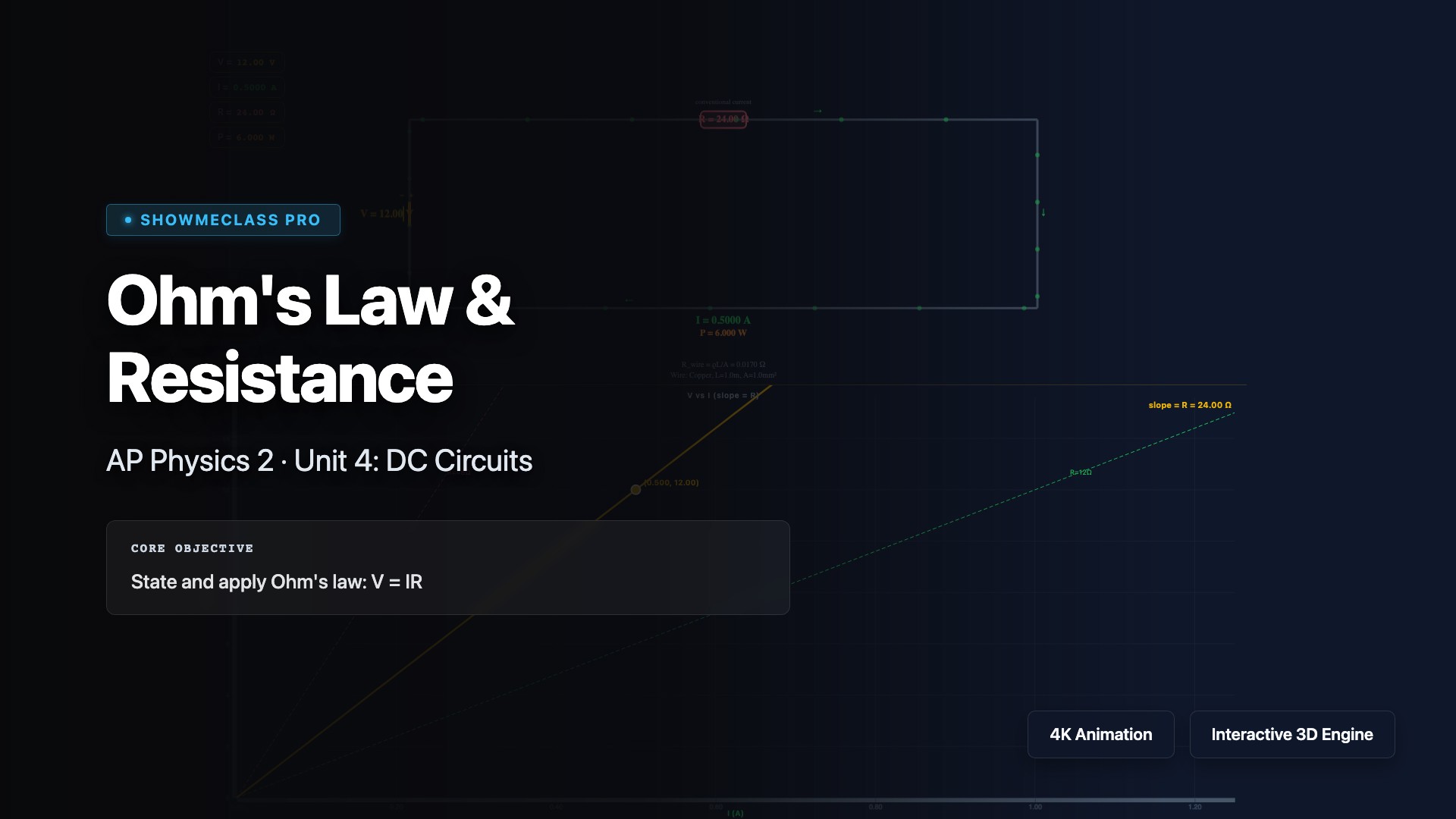
Ohm's Law & Resistance
Explore Ohm's Law stating that voltage across a conductor is proportional to current: V = IR, where R is resistance measured in ohms. Understand how resistance depends on material properties (resistivity ρ), length, and cross-sectional area: R = ρL/A. Calculate power dissipation using P = IV = I²R = V²/R. Analyze how temperature affects resistance, and apply Ohm's Law to solve circuit problems involving series and parallel resistor combinations.

Pascal's Principle & Hydraulic Systems
Explore Pascal's principle stating that pressure applied to a confined fluid is transmitted undiminished throughout the fluid. Understand hydraulic systems where a small force on a small piston creates a large force on a large piston: F₁/A₁ = F₂/A₂. Visualize mechanical advantage in hydraulic lifts, car brakes, and hydraulic presses. Learn how incompressible fluids enable force multiplication while conserving energy through different displacement distances.
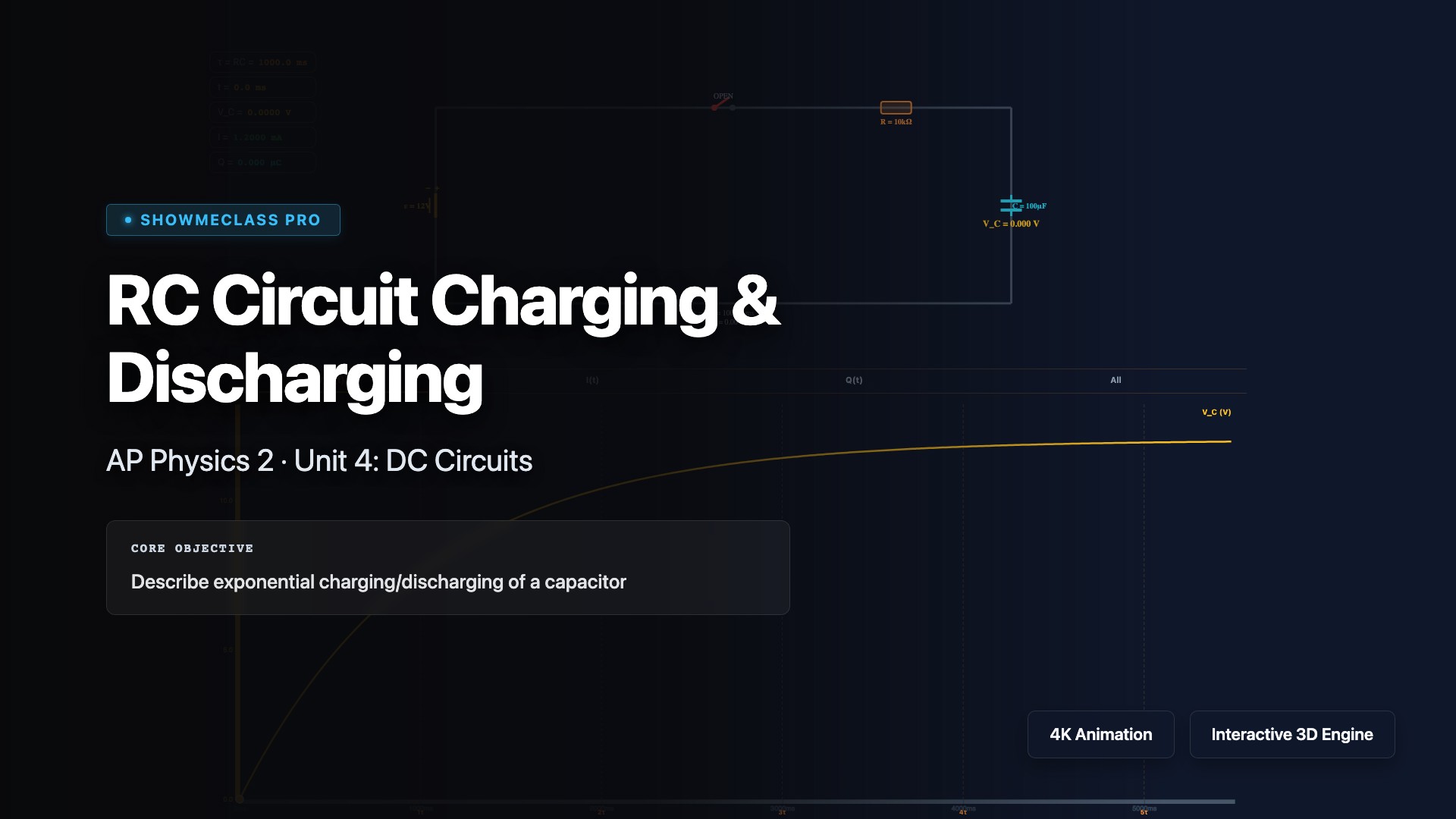
RC Circuit Charging & Discharging
Analyze RC circuits where capacitors charge and discharge through resistors with exponential time dependence. Understand the time constant τ = RC that characterizes how quickly the capacitor charges to 63% of maximum voltage or discharges to 37% of initial voltage. Visualize voltage and current curves using Q(t) = Q₀(1 - e^(-t/τ)) for charging and Q(t) = Q₀e^(-t/τ) for discharging. Apply RC circuits to timing applications, filters, and camera flashes.
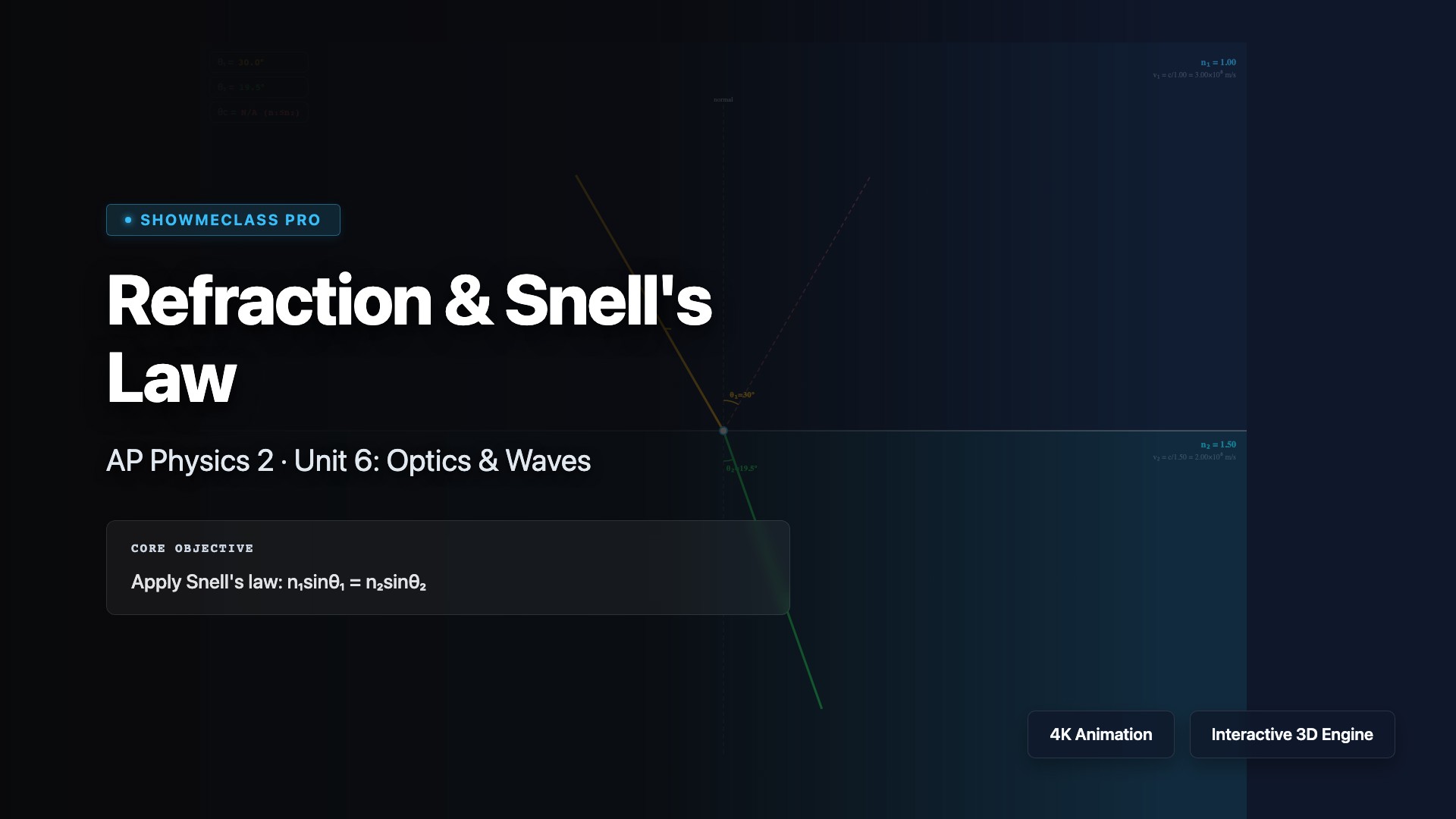
Refraction & Snell's Law
Explore light refraction at interfaces between media using Snell's Law: n₁ sin θ₁ = n₂ sin θ₂, where n is the refractive index. Understand that light bends toward the normal when entering denser media (higher n) and away when entering less dense media. Visualize total internal reflection (TIR) occurring when light travels from high to low index at angles exceeding the critical angle θc = sin⁻¹(n₂/n₁). Apply to fiber optics, prisms, and mirages.
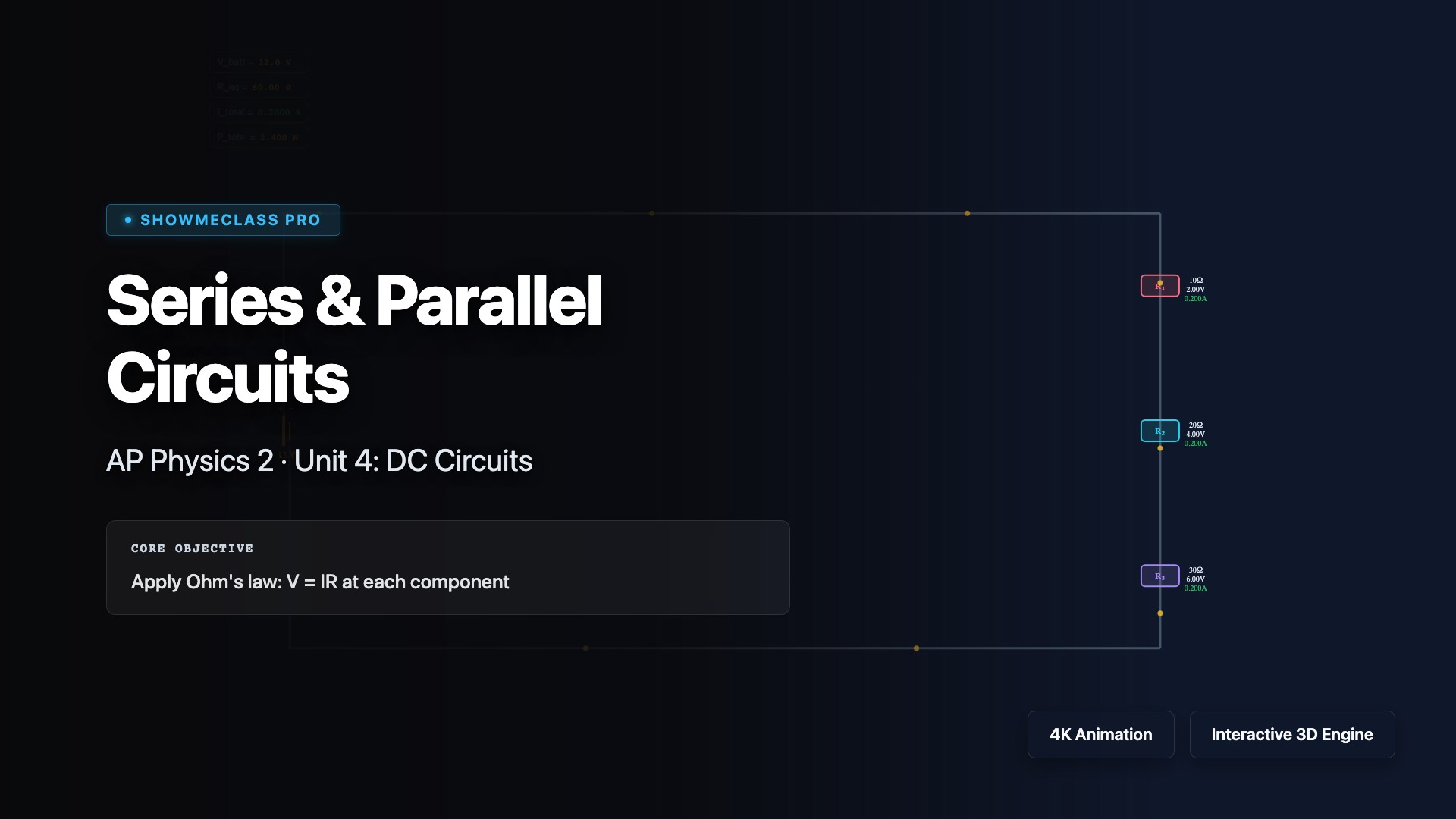
Series & Parallel Circuits
Compare series circuits (single current path, voltage divides, Req = R₁ + R₂ + ...) with parallel circuits (multiple current paths, voltage same across branches, 1/Req = 1/R₁ + 1/R₂ + ...). Apply Kirchhoff's voltage law (sum of voltage drops equals EMF) and current law (current in equals current out at junctions). Analyze complex circuits with mixed series-parallel combinations, calculate equivalent resistance, and determine current and voltage across each component.