Nuclear Fusion Simulator
Animated D-D, D-T, and pp-chain fusion reactions. Shows nucleons, mass defect, energy release (MeV), and required temperature.
WHAT IS NUCLEAR FUSION?
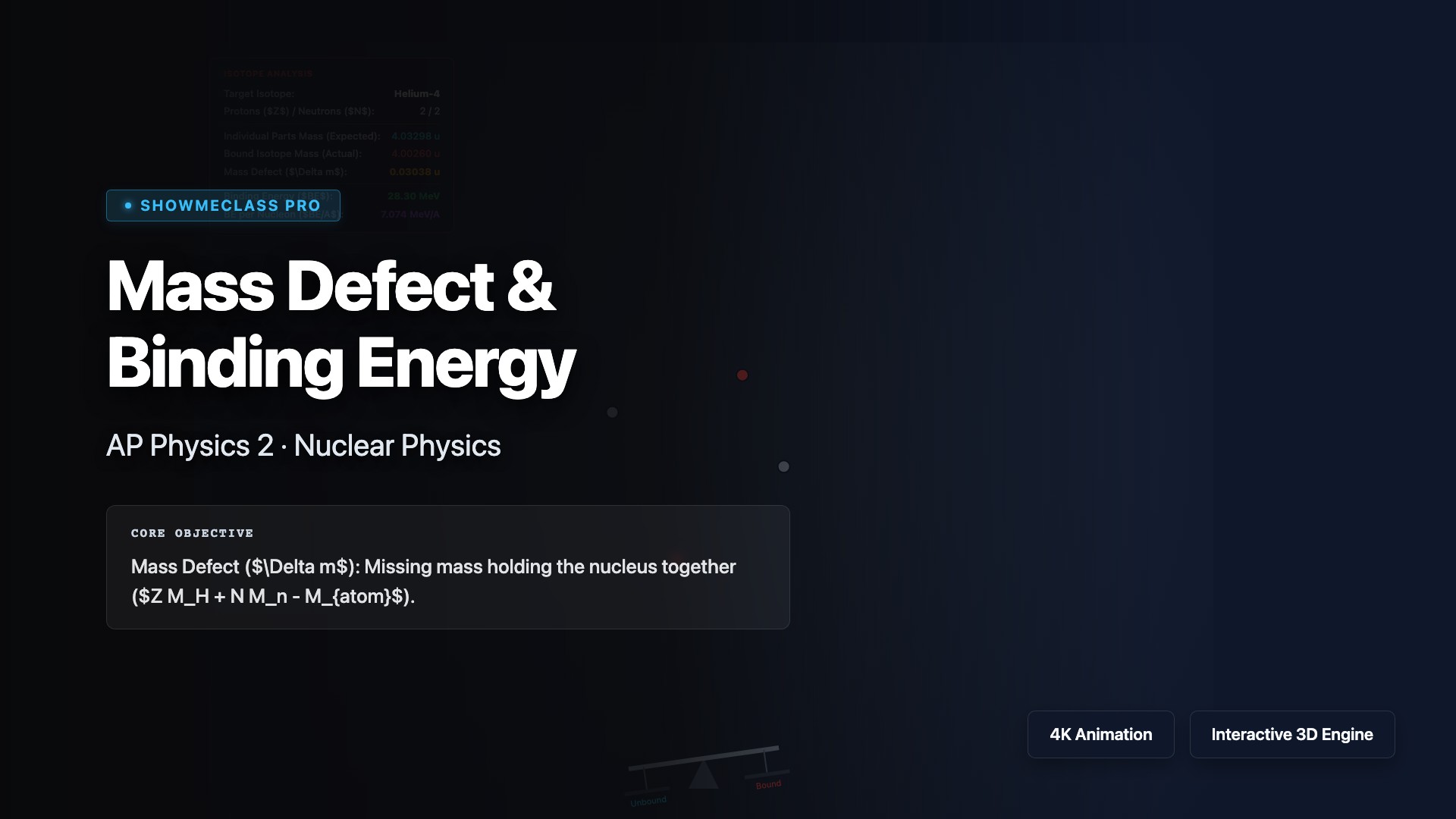
Nuclear fusion is a reaction where two light atomic nuclei combine to form one or more heavier nuclei and subatomic particles. This process releases massive amounts of energy (according to ) because the total mass of the products is less than the mass of the reactants (the **mass defect**). Fusion powers stars and is the goal of future clean energy projects on Earth, though it requires extreme temperatures and pressures to overcome the electrostatic repulsion between nuclei.
HOW TO USE THIS VISUALIZATION
1. **Select a Cycle**: Choose between the Proton-Proton chain (Sun) or D-T (Deuterium-Tritium) fusion. 2. **Adjust Temperature**: Observe the minimum heat required to trigger the reaction. 3. **Track Energy Release**: See how mass is converted into energy as nuclei merge, releasing helium and high-energy neutrons.
CORE FORMULAS
AP EXAM CONNECTION
Unit: Unit 7: Quantum, Atomic, and Nuclear Physics (Topic 7.3)
Learning Objective: LO 7.C.4
COMMON MISCONCEPTIONS
- Fusion and fission are the same (fusion is combining; fission is splitting)
- Mass is lost forever (it is converted into kinetic energy and gamma radiation)
KEY TAKEAWAYS
- Energy release in fusion comes from mass defect.
- Binding energy per nucleon increases for light elements undergoing fusion.
- The Sun primarily fuses hydrogen into helium via the p-p chain.
- Fusion provides much higher energy density than chemical fuels.
PRACTICE QUESTIONS
Q1 (QUANTITATIVE): If the total mass of the reactants in a fusion reaction is 4.033 u and the product mass is 4.002 u, what is the mass defect?
Show Answer & Explanation
Answer: 0.031 u
Explanation: Mass defect atomic mass units (u).
Q2 (CONCEPTUAL): Why does fusion require extreme temperatures?
Show Answer & Explanation
Answer: To overcome the Coulomb barrier
Explanation: Nuclei are positively charged and strongly repel each other (electrostatic force). To bring them close enough for the Strong Nuclear Force to take over, they must have very high kinetic energy (temperature) to collide.
DEEP DIVE: RELATED CONCEPTS
A decay chain is a series of radioactive decays where the radioactive product of one decay is itself...
WHAT IS BLACKBODY RADIATION?A blackbody is an idealized object that absorbs all electromagnetic radiation that falls on it. When...
WHAT IS THE DE BROGLIE WAVELENGTH?In 1924, Louis de Broglie proposed that all matter exhibits wave-like properties. This **wave-partic...