Heat Engine Efficiency Comparator
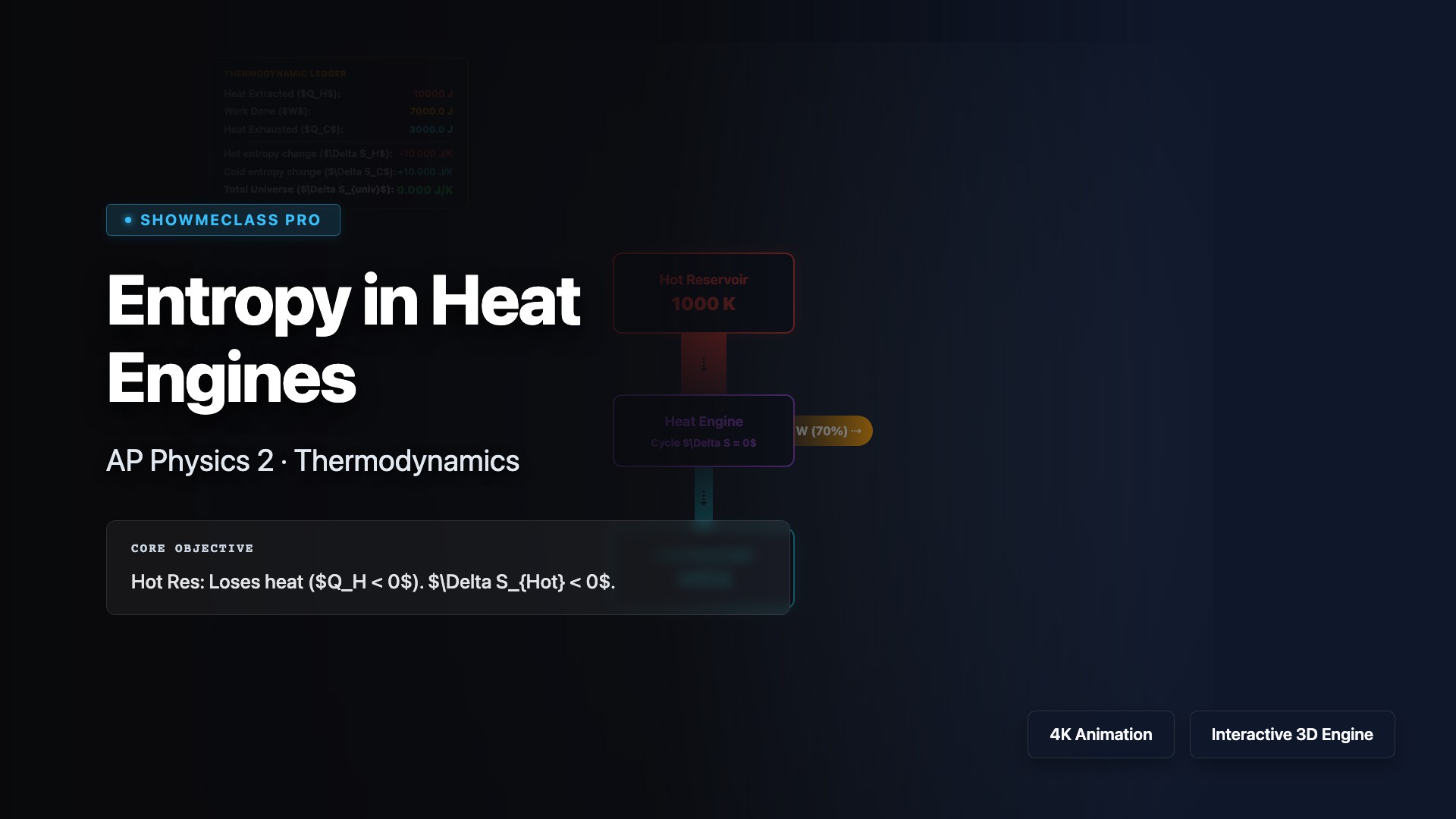
Carnot cycle efficiency diagram: η_max = 1−Tc/Th. Compare actual vs maximum efficiency with energy flow visualization. Impossibility warning when η > η_Carnot.
HEAT ENGINES AND THE SECOND LAW
A heat engine is a device that converts thermal energy into mechanical work by taking heat from a hot reservoir (), performing work (), and exhausting the remaining heat () to a cold reservoir. According to the **Second Law of Thermodynamics**, it is impossible to convert 100% of heat into work; some energy must always be lost as waste heat. The efficiency of an engine is the ratio of the work done to the heat input: .
THE CARNOT CYCLE: MAXIMUM EFFICIENCY
The **Carnot cycle** represents the theoretical upper limit for the efficiency of any heat engine operating between two temperatures, and . It consists of four reversible processes: two isothermal and two adiabatic. The Carnot efficiency depends ONLY on the absolute temperatures (in Kelvin) of the reservoirs: . Real engines always have lower efficiencies due to friction, turbulence, and non-reversible heat transfers.
HOW TO USE THIS VISUALIZATION
1. **Set Reservoir Temperatures**: Adjust the Hot () and Cold () temperature sliders. Observe how the theoretical Carnot efficiency changes. 2. **Run the Cycle**: Watch the engine move through the four stages of the Carnot cycle on the PV diagram. 3. **Analyze Energy Flow**: Track the energy flow diagram (Sankey diagram) to see how is split between useful Work and waste Heat . **Try This**: Set to 600 K and to 300 K. What is the Carnot efficiency? Now, if you want to double the efficiency, should you increase or decrease by the same amount? Use the calculator to verify.
CORE FORMULAS
AP EXAM CONNECTION
Unit: Unit 2: Thermodynamics (Topic 2.2)
Learning Objective: ENE-1.E
COMMON MISCONCEPTIONS
- Using Celsius instead of Kelvin (absolute temperature is required for all gas and heat laws).
- Thinking Carnot efficiency is what real engines achieve (it is a theoretical limit).
- Confusing heat input () with work output ().
KEY TAKEAWAYS
- Engines convert thermal energy to work.
- Carnot cycle is the most efficient possible.
- Second Law forbids 100% efficiency.
- Waste heat () is unavoidable.
- Efficiency increases with larger temperature spans.
PRACTICE QUESTIONS
Q1 (QUANTITATIVE): A heat engine takes in 1000 J of heat and performs 300 J of work. What is its efficiency and how much heat is exhausted?
Show Answer & Explanation
Answer: 30%, 700 J
Explanation: or 30%. From the First Law, , so , which means J.
Q2 (QUANTITATIVE): Calculate the maximum possible efficiency of an engine operating between a steam reservoir at 100°C and a cooling pond at 20°C.
Show Answer & Explanation
Answer: 21.4%
Explanation: Convert to Kelvin: K, K. or 21.4%.
Q3 (CONCEPTUAL): Why can a heat engine never be 100% efficient?
Show Answer & Explanation
Answer: The Second Law of Thermodynamics
Explanation: The Second Law requires that some heat must always be exhausted to a lower temperature reservoir to complete the cycle and satisfy the requirement that entropy must not decrease in a closed system.
DEEP DIVE: RELATED CONCEPTS
In thermodynamics, we study how systems exchange energy with their surroundings through heat and wor...
CONSTANT PRESSURE AND CONSTANT VOLUMEThermodynamic processes are often categorized by the physical properties they keep constant. An **is...
WHAT IS BLACKBODY RADIATION?A blackbody is an idealized object that absorbs all electromagnetic radiation that falls on it. When...