
Showing 12 results
Center of Mass & Momentum in 2D
Calculate the center of mass for multi-particle systems using $\vec{r}_{cm} = \frac{\sum m_i\vec{r}_i}{\sum m_i}$ and analyze 2D collision dynamics. Visualize how momentum conservation applies independently to x and y components in elastic and inelastic collisions.
Damped & Driven Oscillations
Model damped harmonic motion with exponential decay $x(t) = Ae^{-\gamma t}\cos(\omega t)$ and explore driven oscillations at resonance. Visualize how damping coefficients affect amplitude decay and how driving frequencies near natural frequency produce maximum energy transfer.
Gravitational Orbits
Simulate planetary orbits using Newton's law of gravitation $F = \frac{Gm_1m_2}{r^2}$ and explore Kepler's laws of planetary motion. Visualize elliptical trajectories, orbital velocity changes, and the relationship between orbital period and semi-major axis.
Kinematics with Calculus
Apply calculus to motion analysis using $v = \frac{dx}{dt}$ and $a = \frac{dv}{dt}$, and integrate acceleration to find velocity and position functions. Visualize how derivatives and integrals connect position, velocity, and acceleration graphs in real-time.
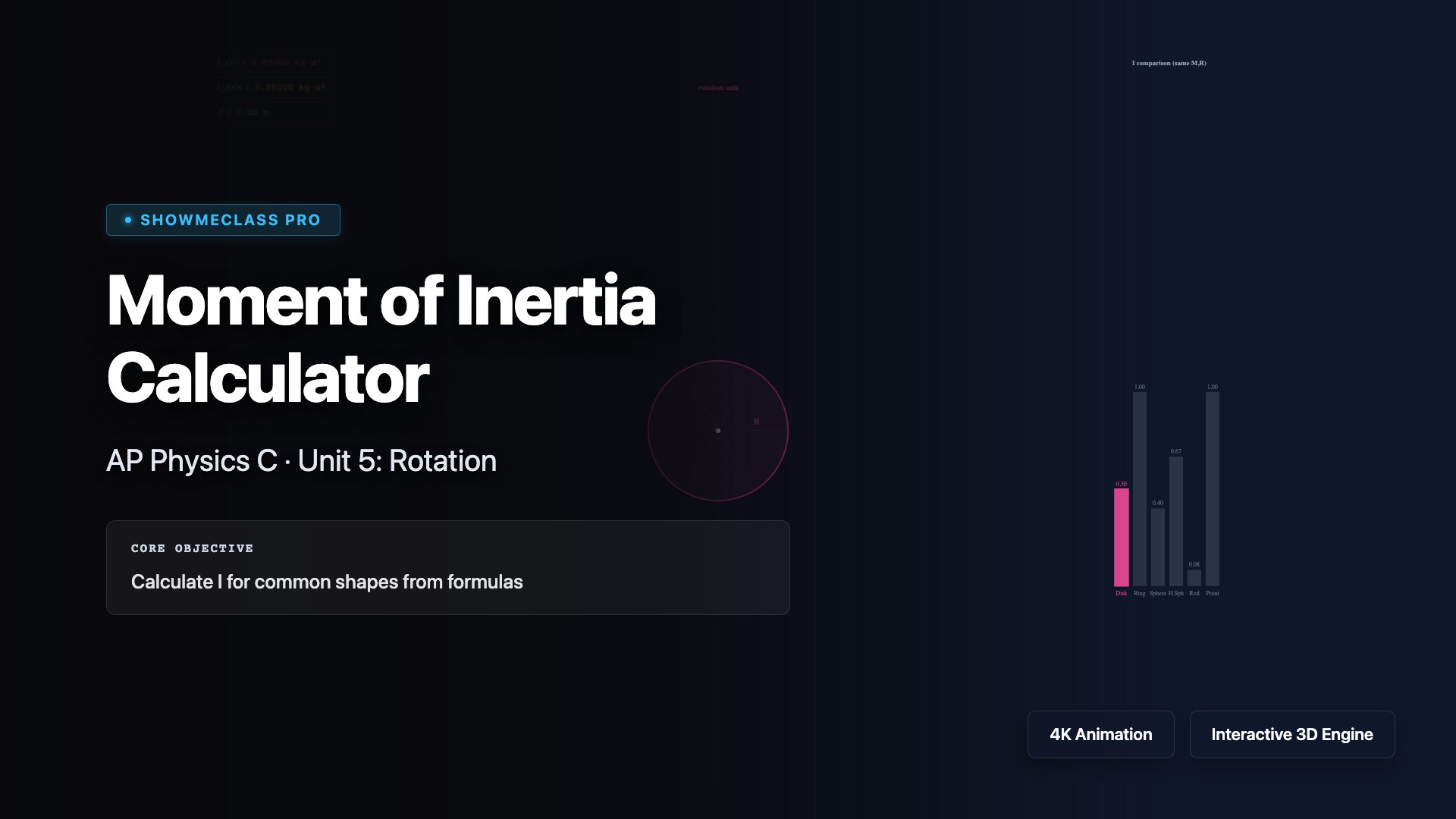
Moment of Inertia Calculator
Calculate moment of inertia $I = \int r^2 dm$ for various geometric shapes and apply the parallel axis theorem $I = I_{cm} + Md^2$. Visualize how mass distribution affects rotational inertia and compare common shapes like disks, spheres, and rods.
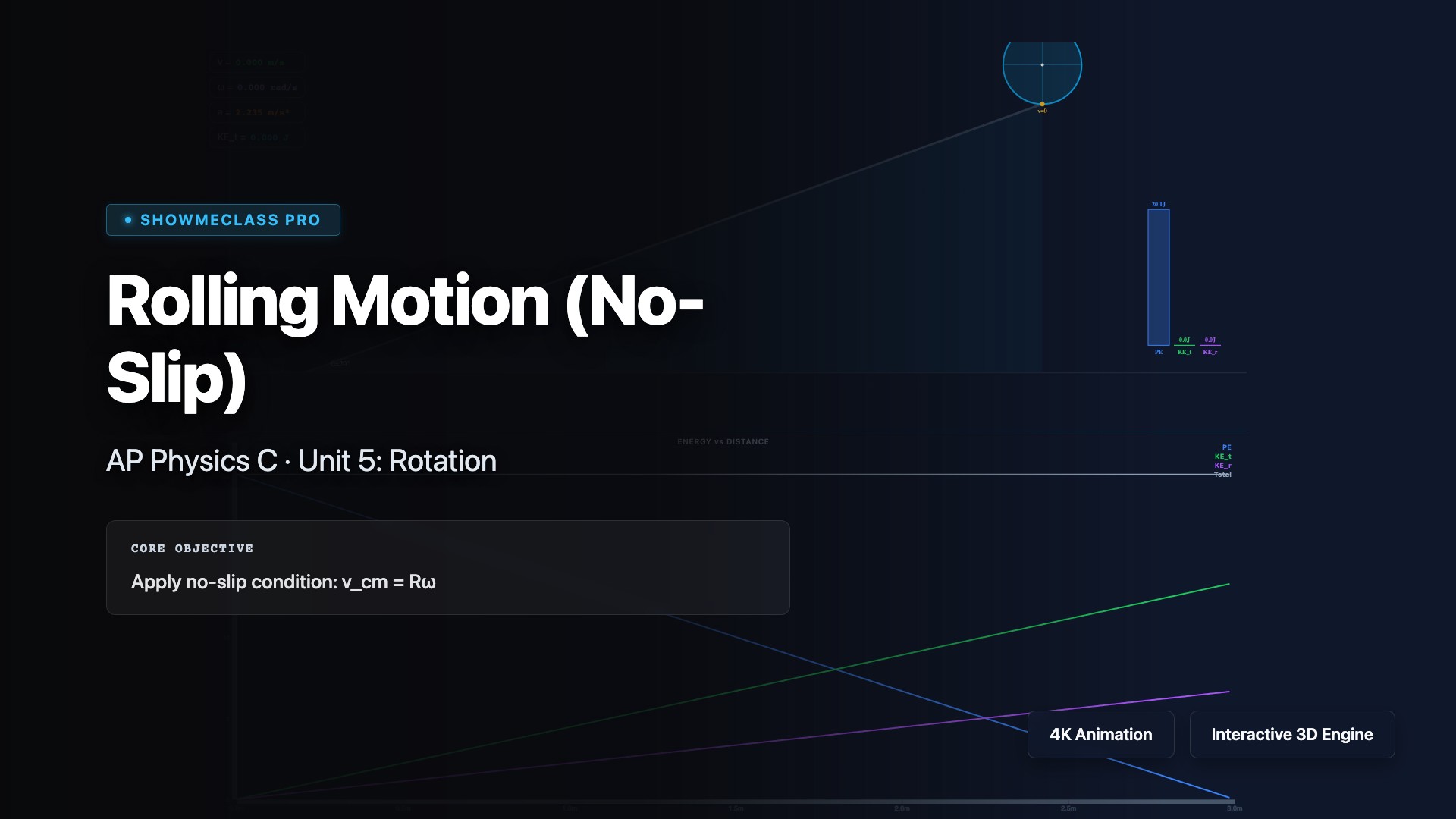
Rolling Motion (No-Slip)
Analyze rolling motion with the no-slip condition $v_{cm} = R\omega$ and explore energy partitioning between translational and rotational kinetic energy. Visualize objects rolling down inclines and see how moment of inertia affects acceleration.
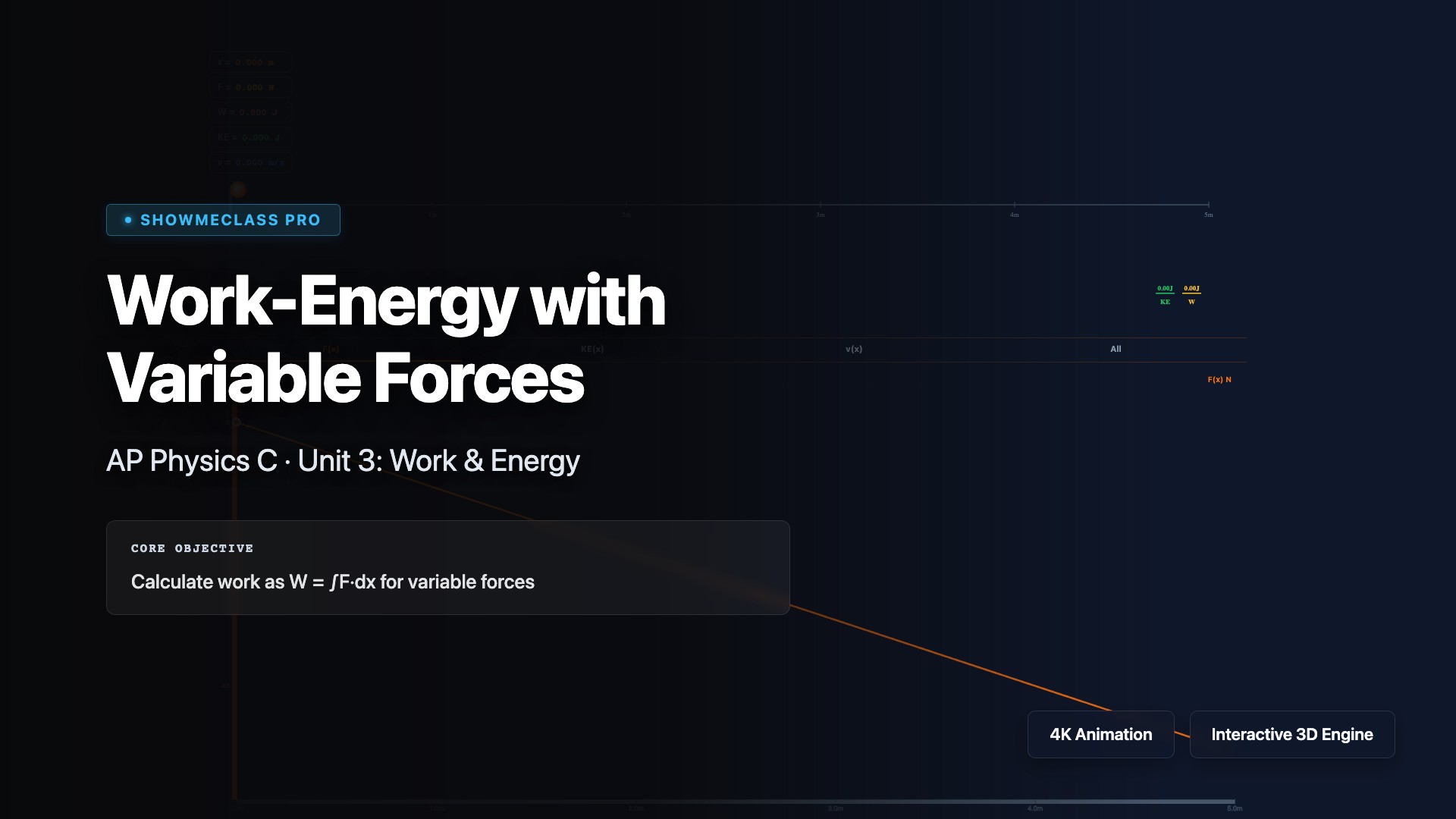
Work-Energy with Variable Forces
Calculate work done by variable forces using the integral $W = \int \vec{F} \cdot d\vec{r}$ and apply the work-energy theorem. Visualize force-displacement graphs and compute work as the area under the curve for springs, gravity, and custom force functions.
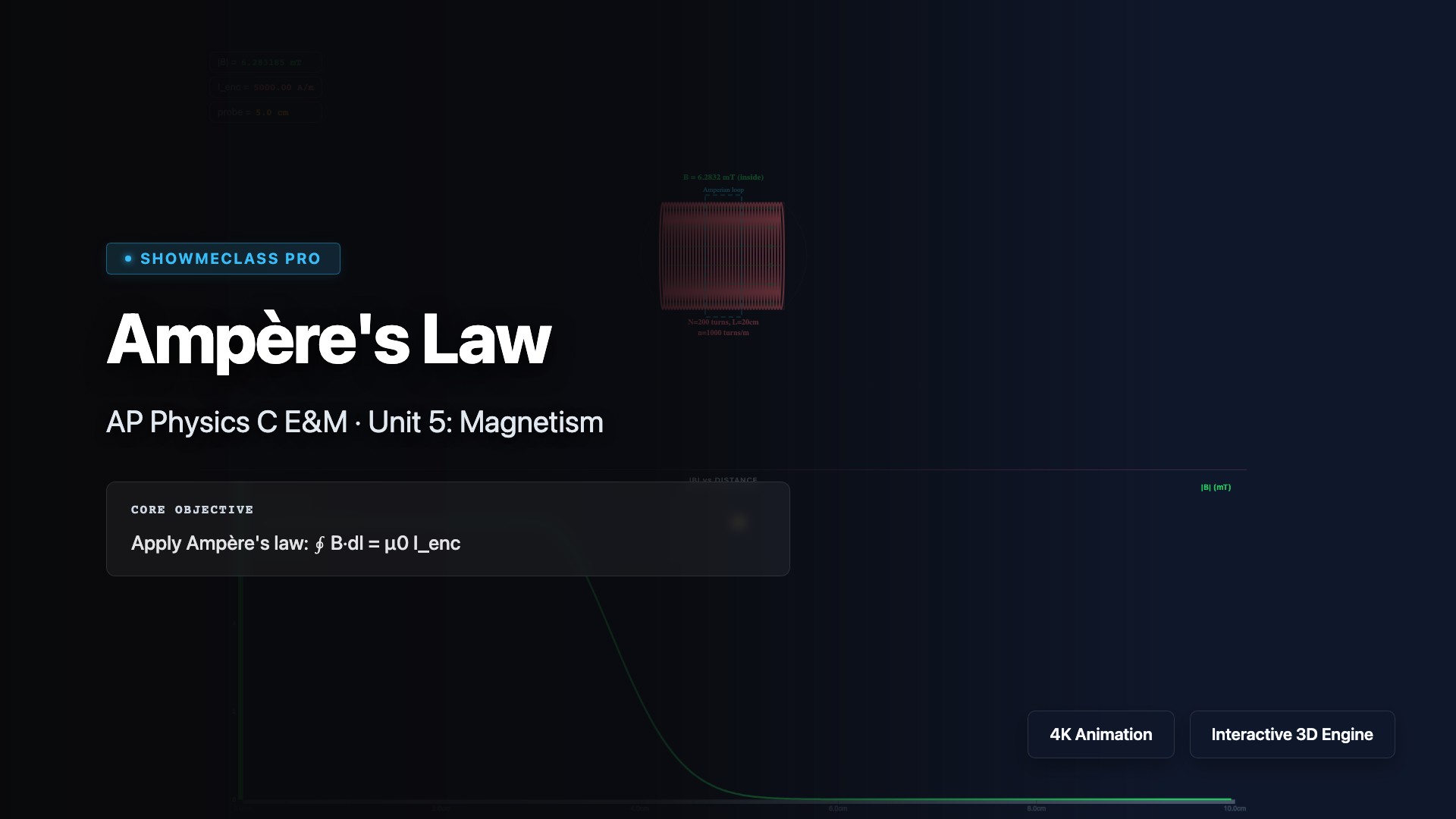
Ampère's Law
Apply Ampère's law $\oint \vec{B} \cdot d\vec{l} = \mu_0 I_{enc}$ to calculate magnetic fields in symmetric configurations. Visualize magnetic field patterns inside solenoids, toroids, and around current-carrying wires using closed loop integration.
Biot-Savart Law & Magnetic Field
Calculate magnetic fields using the Biot-Savart law $d\vec{B} = \frac{\mu_0}{4\pi}\frac{Id\vec{l} \times \hat{r}}{r^2}$ for current-carrying wires. Visualize how current elements contribute to the total magnetic field and explore field patterns around straight wires, loops, and complex geometries.
Capacitor & Dielectric
Explore capacitance $C = \frac{Q}{V}$ and how dielectric materials increase capacitance by reducing the electric field. Visualize energy storage $U = \frac{1}{2}CV^2$ in parallel-plate capacitors and analyze the effects of dielectric constant on charge distribution.
Electric Potential Energy & Potential
Calculate electric potential $V = \frac{kQ}{r}$ and potential energy $U = qV$ for point charges and charge distributions. Visualize equipotential surfaces, explore the relationship $\vec{E} = -\nabla V$, and analyze how charges move from high to low potential.
Faraday's Law & Lenz's Law
Apply Faraday's law $\mathcal{E} = -\frac{d\Phi_B}{dt}$ to calculate induced EMF from changing magnetic flux. Visualize how Lenz's law determines the direction of induced current to oppose flux changes, and explore applications in generators and transformers.