
Showing 12 results
Binary Star System (Barycenter Orbits)
Interactive 3D simulation of a binary star system. Understand center of mass (barycenter), orbital periods, and universal gravitation.

Conservation of Energy
Visualize the law of conservation of energy stating that total mechanical energy (kinetic + potential) remains constant in isolated systems without friction. Explore energy transformations between gravitational potential energy (mgh), elastic potential energy (½kx²), and kinetic energy (½mv²). Understand how work done by non-conservative forces like friction converts mechanical energy to thermal energy, and apply energy conservation to solve problems involving pendulums, roller coasters, and springs.
Elastic & Inelastic Collisions
Compare elastic collisions (both momentum and kinetic energy conserved) with inelastic collisions (only momentum conserved, kinetic energy lost to deformation, heat, sound). Visualize perfectly inelastic collisions where objects stick together after impact. Apply conservation of momentum p₁ᵢ + p₂ᵢ = p₁f + p₂f to calculate final velocities. Understand the coefficient of restitution, and analyze real-world collisions including car crashes, billiard balls, and atomic particle interactions.
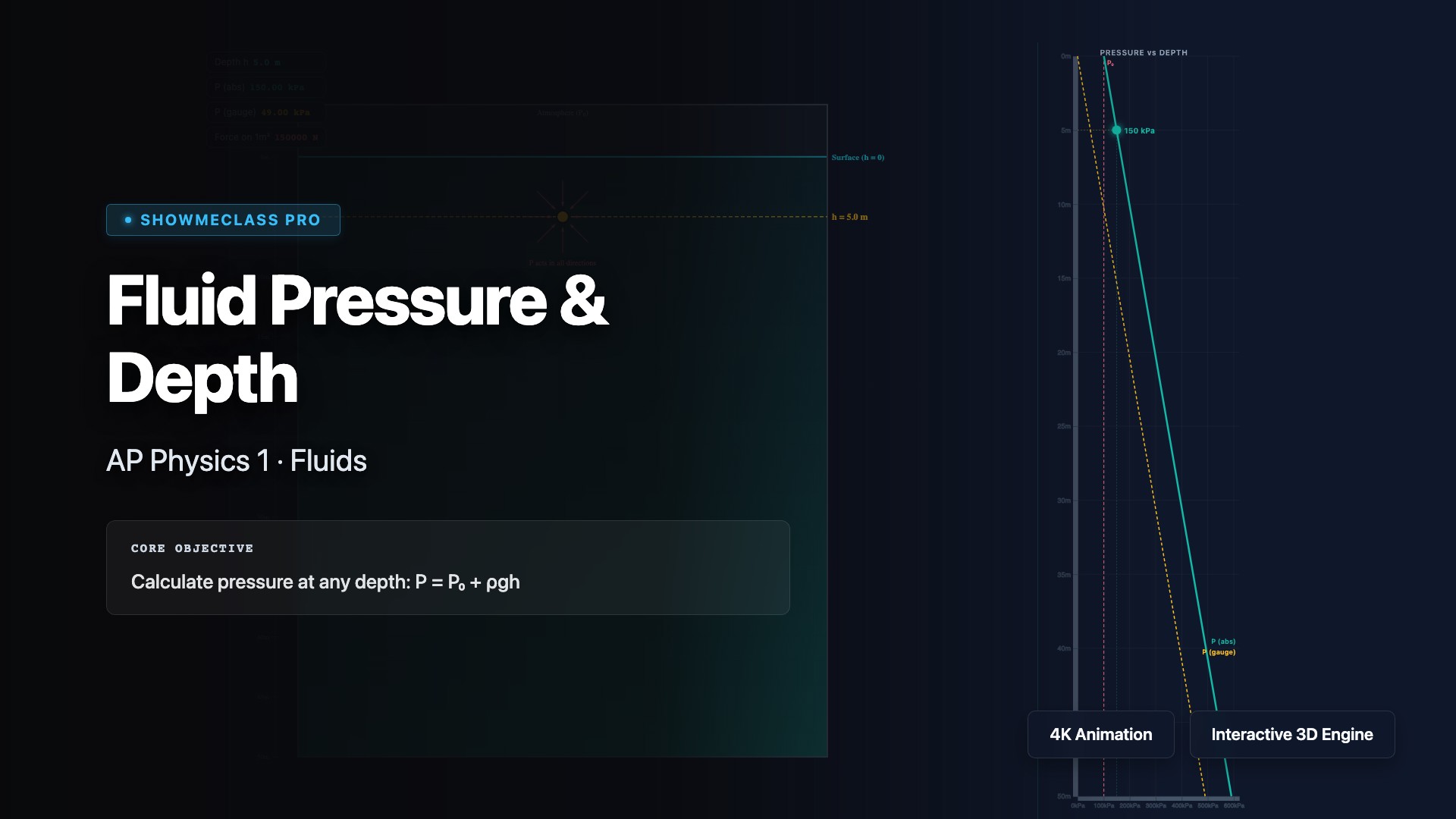
Fluid Pressure & Depth
Explore how fluid pressure increases with depth according to P = P₀ + ρgh, where P₀ is atmospheric pressure, ρ is fluid density, g is gravitational acceleration, and h is depth. Understand Pascal's principle stating that pressure applied to a confined fluid is transmitted equally throughout the fluid. Visualize applications including hydraulic lifts, dam design, submarine pressure limits, and why water pressure increases as divers descend deeper underwater.
Free Body Diagram Builder
Build free body diagrams (FBDs) to visualize all forces acting on an object as vectors from its center of mass. Practice identifying forces including weight (mg downward), normal force (perpendicular to surface), friction (parallel to surface, opposing motion), tension (along rope/string), and applied forces. Master using FBDs to apply Newton's second law ΣF = ma by resolving forces into components and solving for unknowns in equilibrium and accelerating systems.
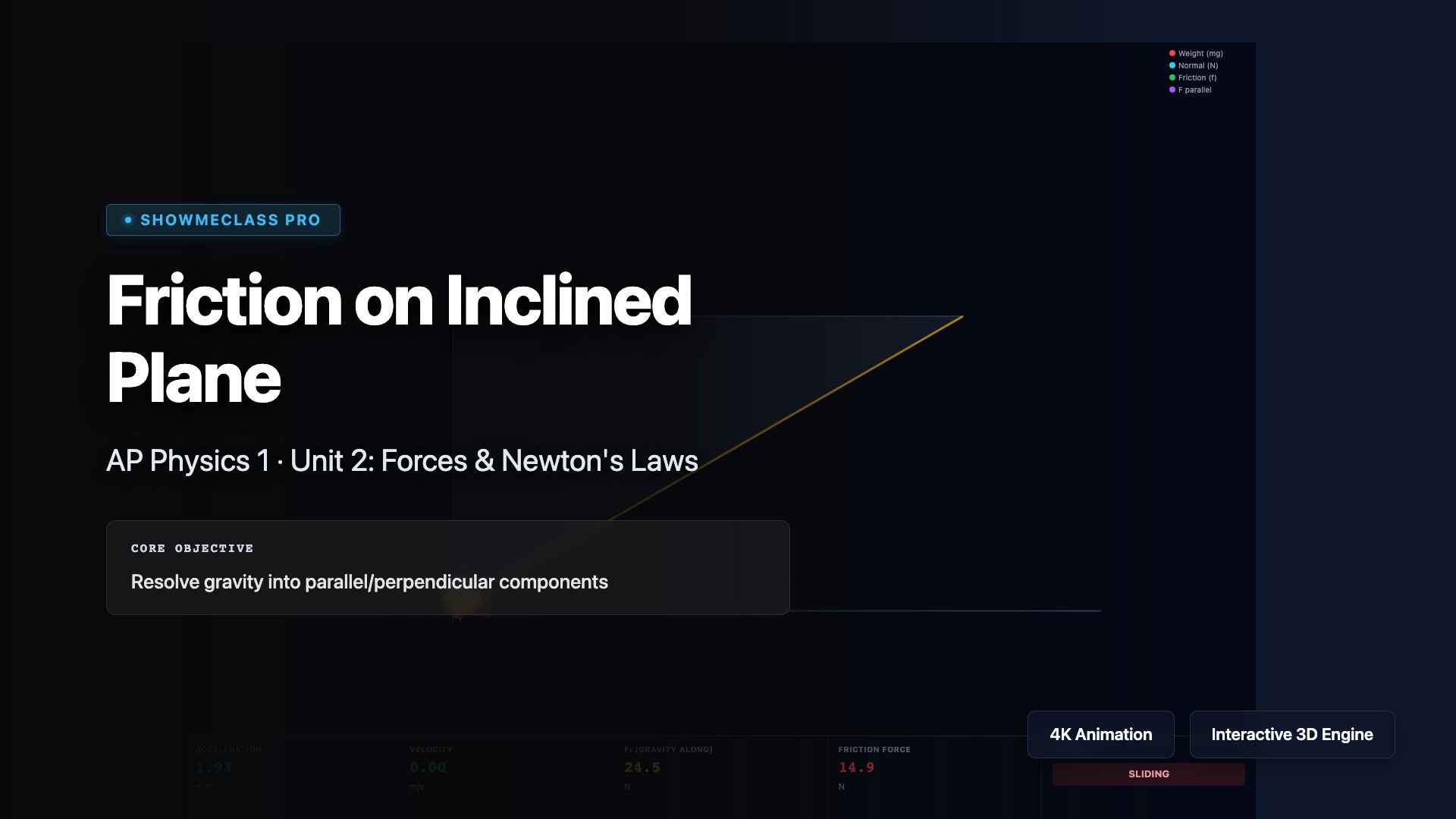
Friction on Inclined Plane
Analyze forces on objects on inclined planes including weight components (mg sin θ parallel to slope, mg cos θ perpendicular), normal force, and friction. Understand static friction (fs ≤ μsN prevents motion) versus kinetic friction (fk = μkN opposes motion). Practice decomposing forces, determining whether objects slide or remain stationary, calculating acceleration down slopes, and finding the critical angle where objects begin to slip based on the coefficient of static friction.
Gravitational Potential Energy Well
Interactive 3D potential energy well simulator. Understand negative gravitational potential energy, kinetic energy, and escape velocity.
Impulse & Momentum
Explore the impulse-momentum theorem stating that impulse (J = FΔt) equals change in momentum (Δp = mΔv). Visualize how force applied over time changes an object's momentum, and understand why extending collision time (airbags, crumple zones, landing on soft surfaces) reduces peak force by spreading impulse over longer duration. Apply J = Δp to analyze collisions, rocket propulsion, and sports scenarios where controlling force duration matters.
1D Kinematics: Position, Velocity & Acceleration
Explore one-dimensional motion through position-time, velocity-time, and acceleration-time graphs. Understand that velocity is the derivative of position (v = dx/dt) and acceleration is the derivative of velocity (a = dv/dt). Practice using kinematic equations for constant acceleration: v = v₀ + at, x = x₀ + v₀t + ½at², and v² = v₀² + 2aΔx. Interpret graph slopes and areas to analyze motion, and solve problems involving free fall, braking, and accelerating objects.
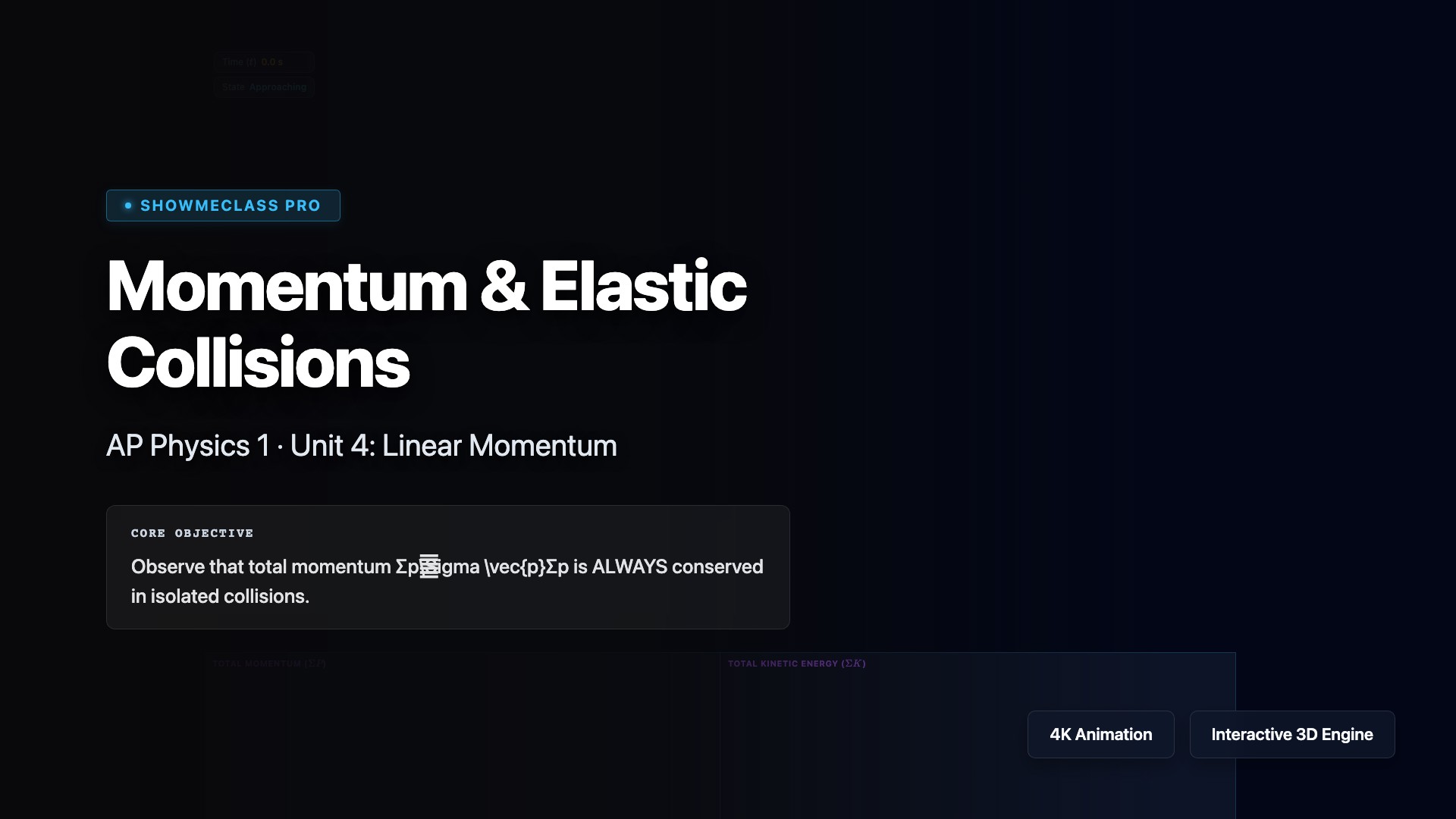
Momentum & Elastic Collisions
Interactive 1D collision physics simulator. Explore elastic and inelastic collisions, coefficient of restitution, and live momentum/energy conservation charts.
Newton's Second Law
Explore Newton's second law stating that net force equals mass times acceleration (ΣF = ma). Understand that acceleration is directly proportional to net force and inversely proportional to mass. Practice applying F = ma to calculate unknown forces, masses, or accelerations in various scenarios. Visualize how multiple forces combine vectorially to produce net force, and solve problems involving tension, friction, gravity, and applied forces on objects in equilibrium or accelerating motion.
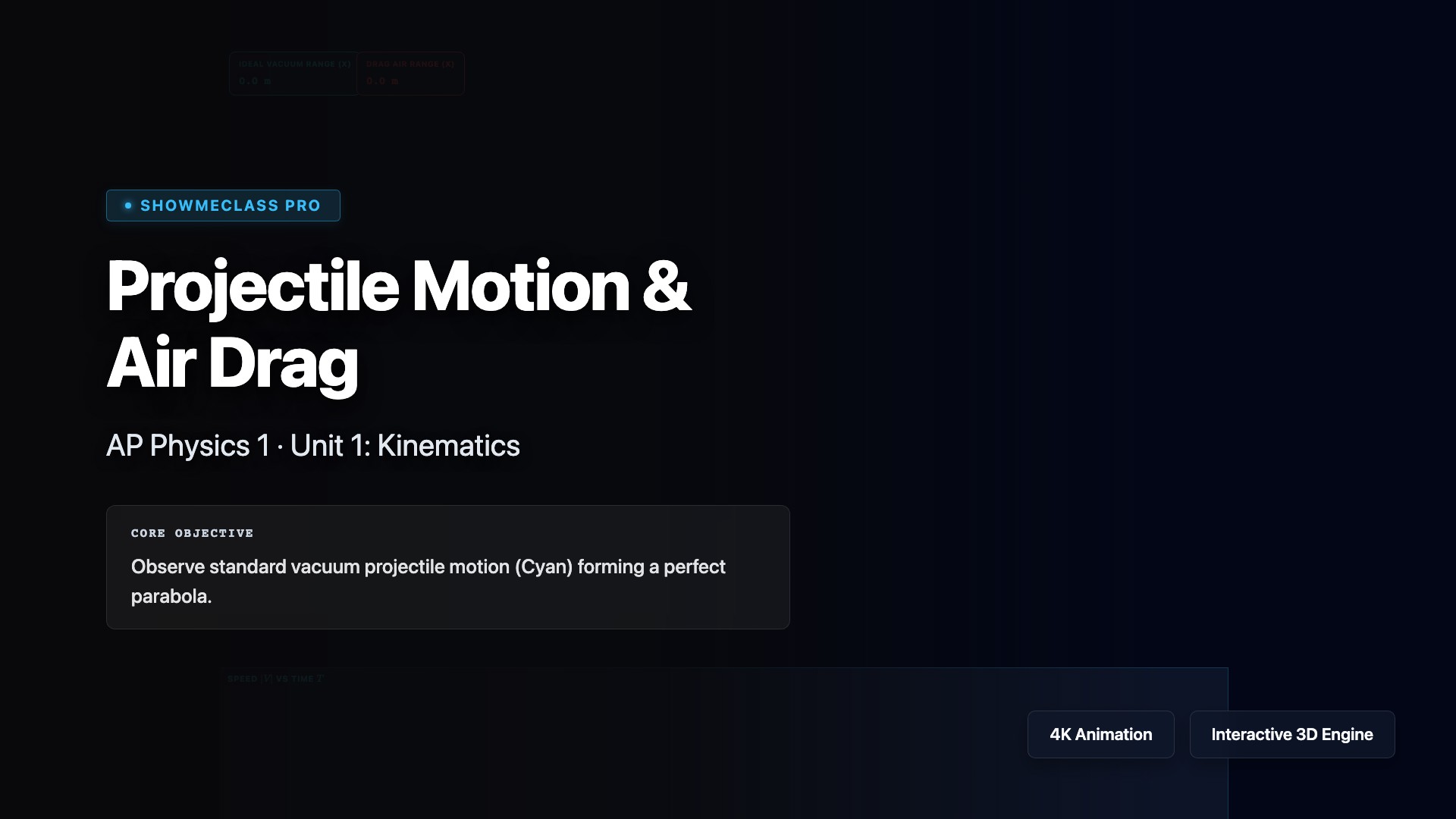
Projectile Motion & Air Drag
Interactive 3D physics simulator comparing ideal projectile motion to realistic air resistance. Graph terminal velocity and explore nonlinear trajectories.