
Showing 12 results
Free Body Diagram Builder
Build free body diagrams (FBDs) to visualize all forces acting on an object as vectors from its center of mass. Practice identifying forces including weight (mg downward), normal force (perpendicular to surface), friction (parallel to surface, opposing motion), tension (along rope/string), and applied forces. Master using FBDs to apply Newton's second law ΣF = ma by resolving forces into components and solving for unknowns in equilibrium and accelerating systems.
Friction on Inclined Plane
Analyze forces on objects on inclined planes including weight components (mg sin θ parallel to slope, mg cos θ perpendicular), normal force, and friction. Understand static friction (fs ≤ μsN prevents motion) versus kinetic friction (fk = μkN opposes motion). Practice decomposing forces, determining whether objects slide or remain stationary, calculating acceleration down slopes, and finding the critical angle where objects begin to slip based on the coefficient of static friction.
Gravitational Potential Energy Well
Interactive 3D potential energy well simulator. Understand negative gravitational potential energy, kinetic energy, and escape velocity.
Impulse & Momentum
Explore the impulse-momentum theorem stating that impulse (J = FΔt) equals change in momentum (Δp = mΔv). Visualize how force applied over time changes an object's momentum, and understand why extending collision time (airbags, crumple zones, landing on soft surfaces) reduces peak force by spreading impulse over longer duration. Apply J = Δp to analyze collisions, rocket propulsion, and sports scenarios where controlling force duration matters.
1D Kinematics: Position, Velocity & Acceleration
Explore one-dimensional motion through position-time, velocity-time, and acceleration-time graphs. Understand that velocity is the derivative of position (v = dx/dt) and acceleration is the derivative of velocity (a = dv/dt). Practice using kinematic equations for constant acceleration: v = v₀ + at, x = x₀ + v₀t + ½at², and v² = v₀² + 2aΔx. Interpret graph slopes and areas to analyze motion, and solve problems involving free fall, braking, and accelerating objects.
Momentum & Elastic Collisions
Interactive 1D collision physics simulator. Explore elastic and inelastic collisions, coefficient of restitution, and live momentum/energy conservation charts.
Newton's Second Law
Explore Newton's second law stating that net force equals mass times acceleration (ΣF = ma). Understand that acceleration is directly proportional to net force and inversely proportional to mass. Practice applying F = ma to calculate unknown forces, masses, or accelerations in various scenarios. Visualize how multiple forces combine vectorially to produce net force, and solve problems involving tension, friction, gravity, and applied forces on objects in equilibrium or accelerating motion.
Projectile Motion & Air Drag
Interactive 3D physics simulator comparing ideal projectile motion to realistic air resistance. Graph terminal velocity and explore nonlinear trajectories.
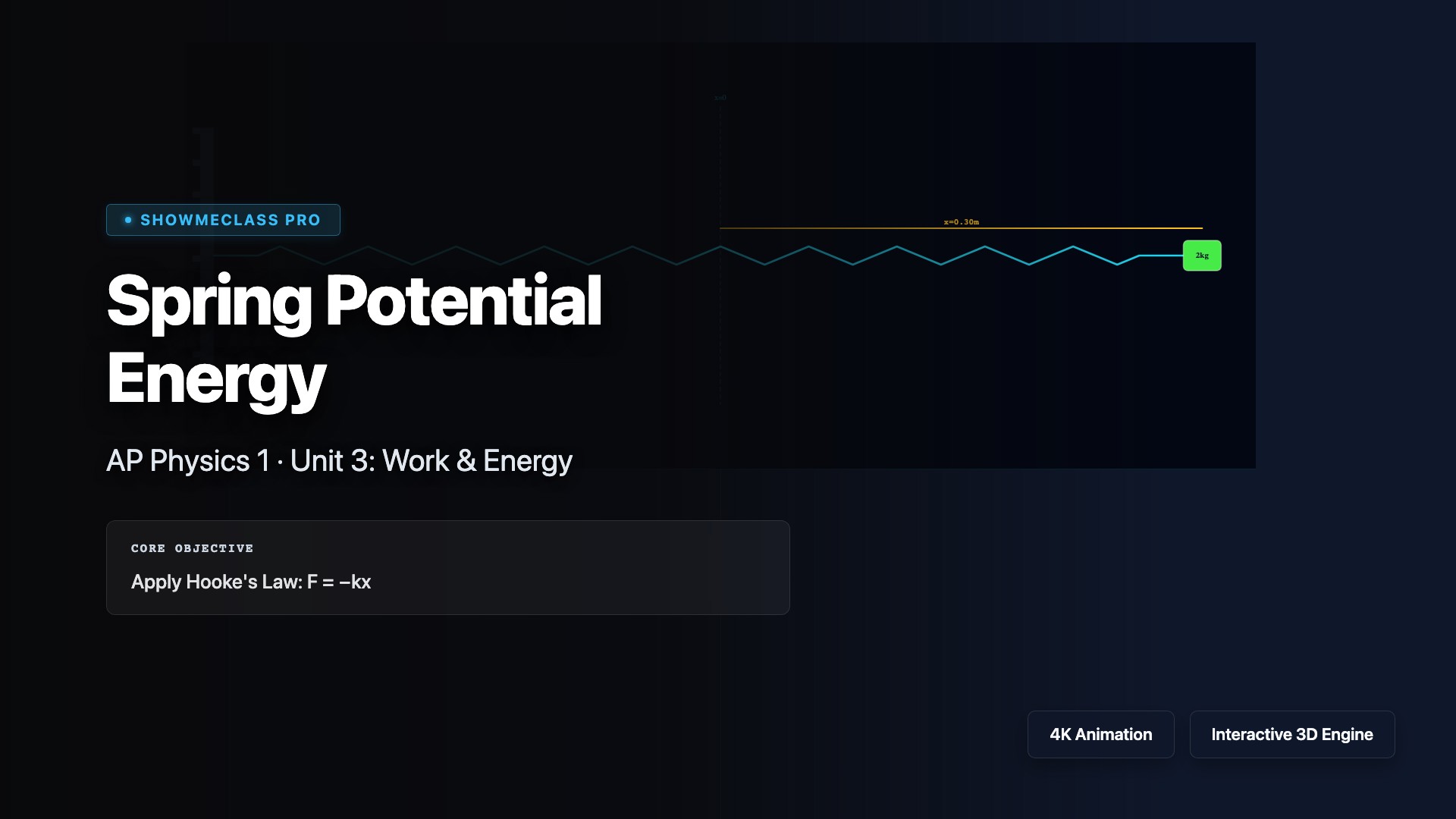
Spring Potential Energy
Explore elastic potential energy stored in springs using Hooke's Law (F = -kx) and the energy formula PEspring = ½kx², where k is the spring constant and x is displacement from equilibrium. Visualize how compressing or stretching a spring stores energy that can be converted to kinetic energy. Apply conservation of energy to spring-mass systems, understand the relationship between spring stiffness and stored energy, and solve problems involving springs in toys, shock absorbers, and oscillating systems.
Velocity
Analyze velocity-time graphs to understand motion characteristics. Learn that the slope of a v-t graph gives acceleration, and the area under the curve represents displacement. Practice interpreting constant velocity (horizontal line), constant acceleration (straight slope), and changing acceleration (curved line). Understand how positive/negative slopes indicate speeding up/slowing down, and how the graph connects to position-time and acceleration-time representations of motion.
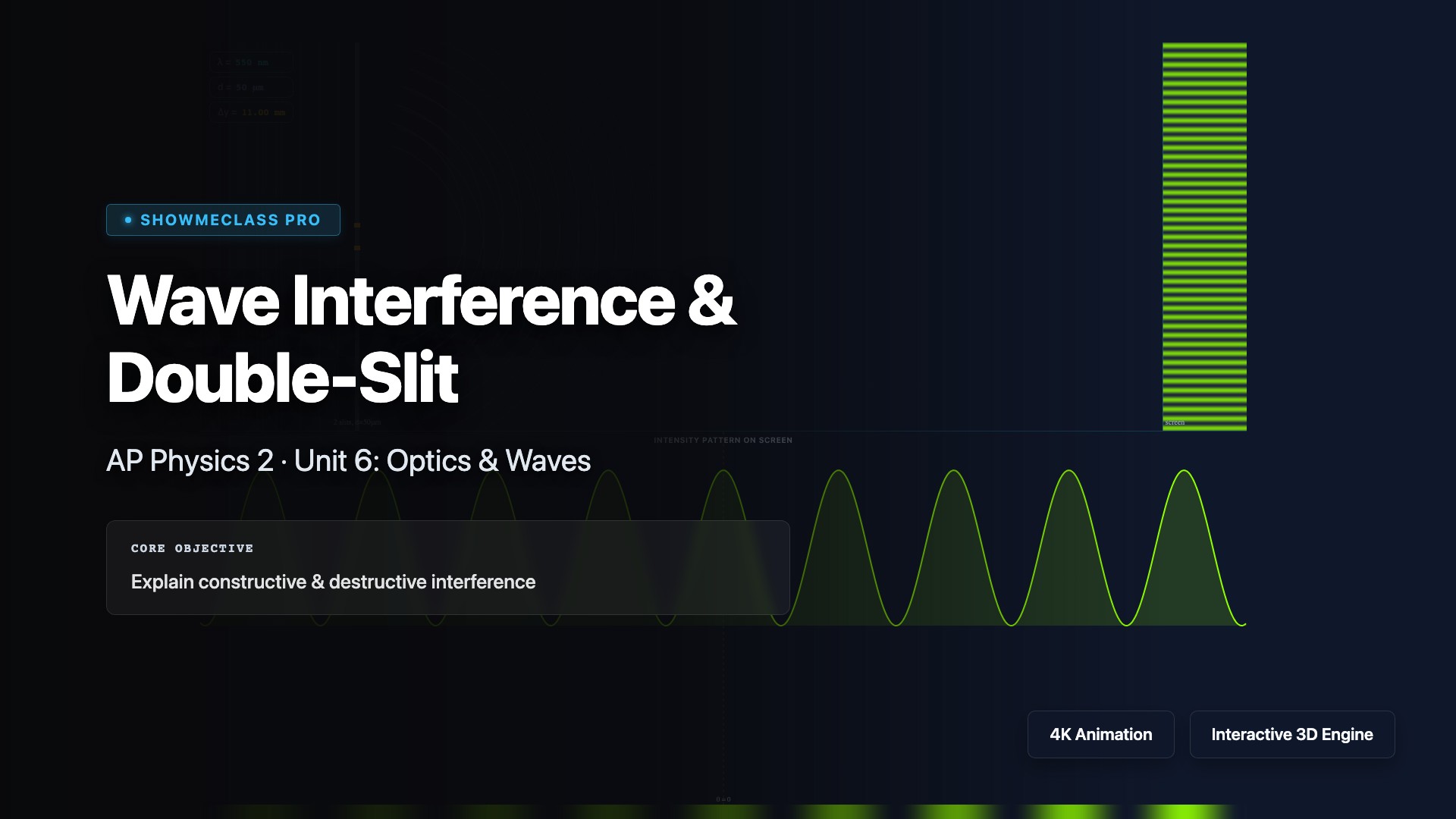
Wave Interference & Superposition
Interactive 3D ripple tank for studying mechanical wave interference. Manipulate wavelength, frequency, and source distance to observe nodal lines and superposition.
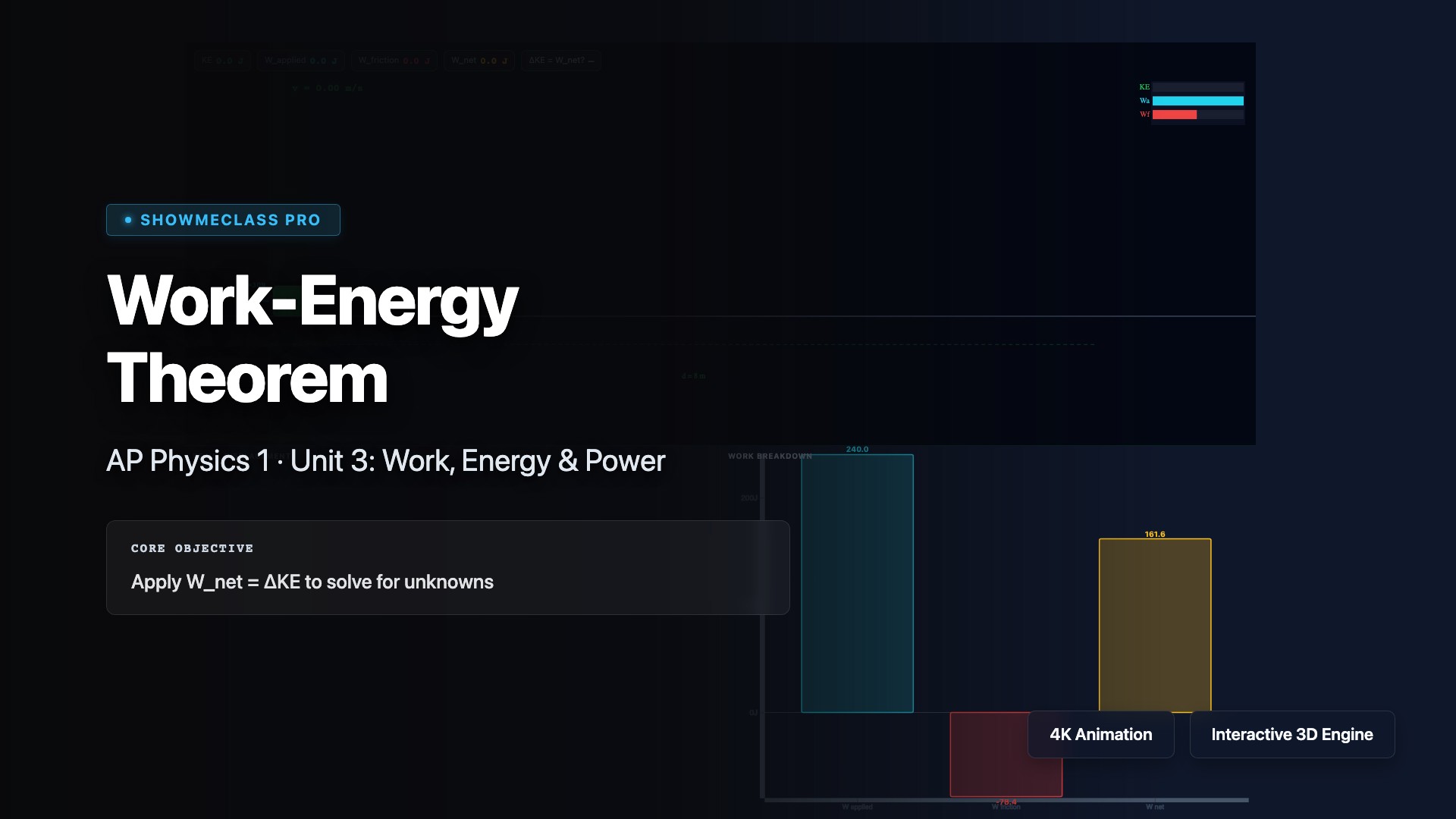
Work
Explore the work-energy theorem stating that net work done on an object equals its change in kinetic energy (Wnet = ΔKE). Understand that work is force times displacement in the direction of force (W = Fd cos θ), measured in joules. Visualize how positive work increases kinetic energy, negative work decreases it, and perpendicular forces do zero work. Apply the theorem to analyze motion with varying forces, friction, and gravitational effects.